How to Optimize Your Website for AI Search Engines (The Complete Guide for Small Businesses)
Summary
AI search optimization (AEO) means structuring your website content so AI assistants like ChatGPT, Google AI Overviews, and voice search cite you as the authoritative answer. Start by ensuring your foundation is solid (mobile-friendly website, complete Google Business Profile, accurate NAP across directories), then implement these key strategies:
- Answer specific questions with clear, concise responses in the first 2-3 sentences
- Use structured formatting with descriptive headers, bullet points, and tables,
- Implement schema markup (FAQPage, HowTo, LocalBusiness)
- Create comprehensive FAQ sections
- Write conversationally for voice search
- Include local context and expertise
- Keep content updated and factually accurate. AI search engines prioritize content that’s easy to extract, well-structured, and demonstrates genuine expertise, not just keyword-optimized pages.
Reading time: 12 minutes
Search has fundamentally changed.
When someone needs a plumber, they’re not just typing “plumber near me” into Google anymore. They’re asking their phone, “Why is my water heater making noise?” They’re asking ChatGPT, “What should I look for in an HVAC company?” They’re asking Alexa, “Who does the best roof repairs in my area?”
And here’s what matters: These AI assistants give ONE answer. One authoritative response.
If your website isn’t optimized for AI search engines, you’re invisible in these searches, even if you rank well in traditional Google results.
If your website isn’t optimized for AI search engines, you’re invisible in these searches. To understand where you currently stand and how to move forward without the overwhelm, read our guide: Are You Being Left Behind? The Truth About AI and Your Business (And Where to Actually Start).
But here’s the opportunity: Most businesses haven’t optimized for AI search yet. If you do this now, you position yourself as the go-to expert before your competitors even understand what’s happening.
This guide will show you exactly how to optimize your website for AI search engines with clear, actionable steps you can implement whether you’re tech-savvy or not.
Let’s start with understanding what’s actually changed and why it matters for your business.
What Is AI Search Optimization (And Why Traditional SEO Isn’t Enough Anymore)
First, let’s clarify what we’re talking about.
Traditional SEO (Search Engine Optimization) focuses on ranking high in search results so people click through to your website.
AI Search Optimization (also called Answer Engine Optimization or AEO) focuses on being selected as THE answer that AI assistants provide directly to users, often without them ever visiting your website.
The Fundamental Shift in Search Behavior
Traditional search (what used to happen):
- User types: “roof repair cost”
- Google shows 10 ranked results
- User clicks multiple websites
- User compares information
- User makes decision
AI-powered search (what happens now):
- User asks: “How much does roof repair typically cost in [city]?”
- AI assistant provides direct answer (extracted from ONE authoritative source)
- User gets specific information immediately
- User contacts the business cited as the expert
See the difference? You’re not competing to be #1 in a list of 10. You’re competing to be THE ONE answer the AI provides.
Traditional SEO focuses on ranking high, while AI Search Optimization focuses on being selected as THE answer. For a deeper look at how this specifically impacts your local rankings and Google Business Profile, see How AI is Changing SEO for Local Businesses (And What You Actually Need to Know).
Where AI Search Is Happening Right Now
Your customers are using AI search through:
- Google AI Overviews (appearing in 84% of search results)
- ChatGPT (100+ million weekly users, now with web search)
- Voice assistants (Siri, Alexa, Google Assistant)
- Bing Chat (Microsoft’s AI-powered search)
- Perplexity AI (growing AI search engine)
- Claude (Anthropic’s AI assistant)
Each of these platforms is pulling answers from websites—potentially YOUR website—to provide to users.
The goal is no longer just appearing in a list, but being the authoritative answer for your community. You don’t have to out spend national giants to win; learn why Stop Trying to Compete with Big Brands! Your Secret Weapon is Local SEO is your most effective path to growth.
The question is: Are they citing you, or your competitors?
The Biggest Mistake Small Businesses Make with AI Search Optimization
Before we dive into how to optimize, let’s address the mistake that wastes the most time:
Trying to optimize for AI search before your foundation is solid.
I see this constantly:
- Business owners hear about AI search
- They rush to “optimize for ChatGPT”
- They restructure content and add fancy formatting
- Nothing happens
Why?
Because AI search engines pull from websites that are already credible, well-structured, and authoritative. If your foundation is weak, AI assistants won’t consider your content trustworthy enough to cite—no matter how well you format it.
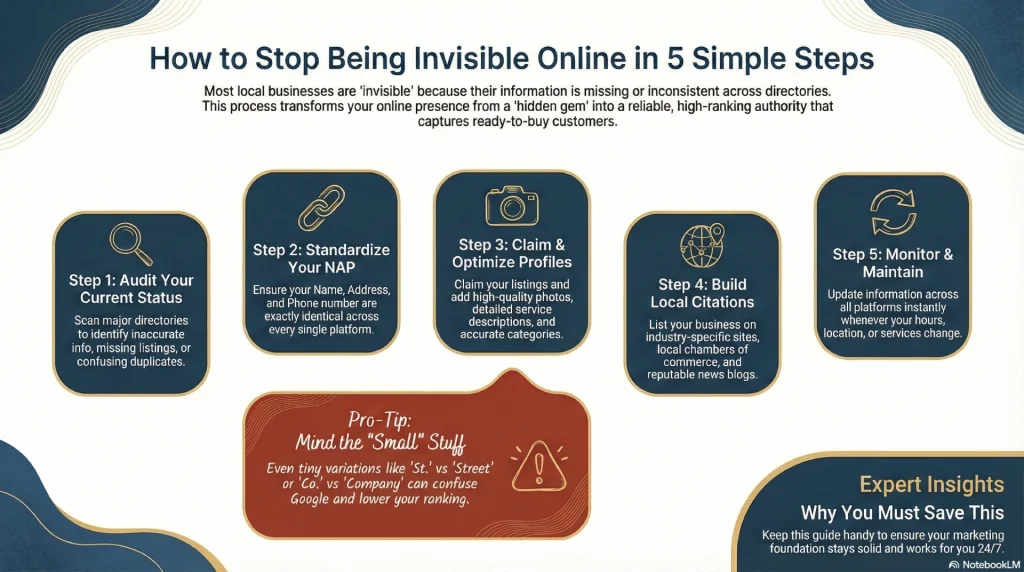
If your foundation is weak, AI assistants won’t consider your content trustworthy enough to cite. To fix these gaps and ensure you are reachable, learn Why Your Business Is Invisible (And How Online Directories and Citations Fix It)
The Foundation You Need BEFORE AI Search Optimization
✓ Professional, mobile-friendly website with fast loading speed
✓ Complete, optimized Google Business Profile with accurate information
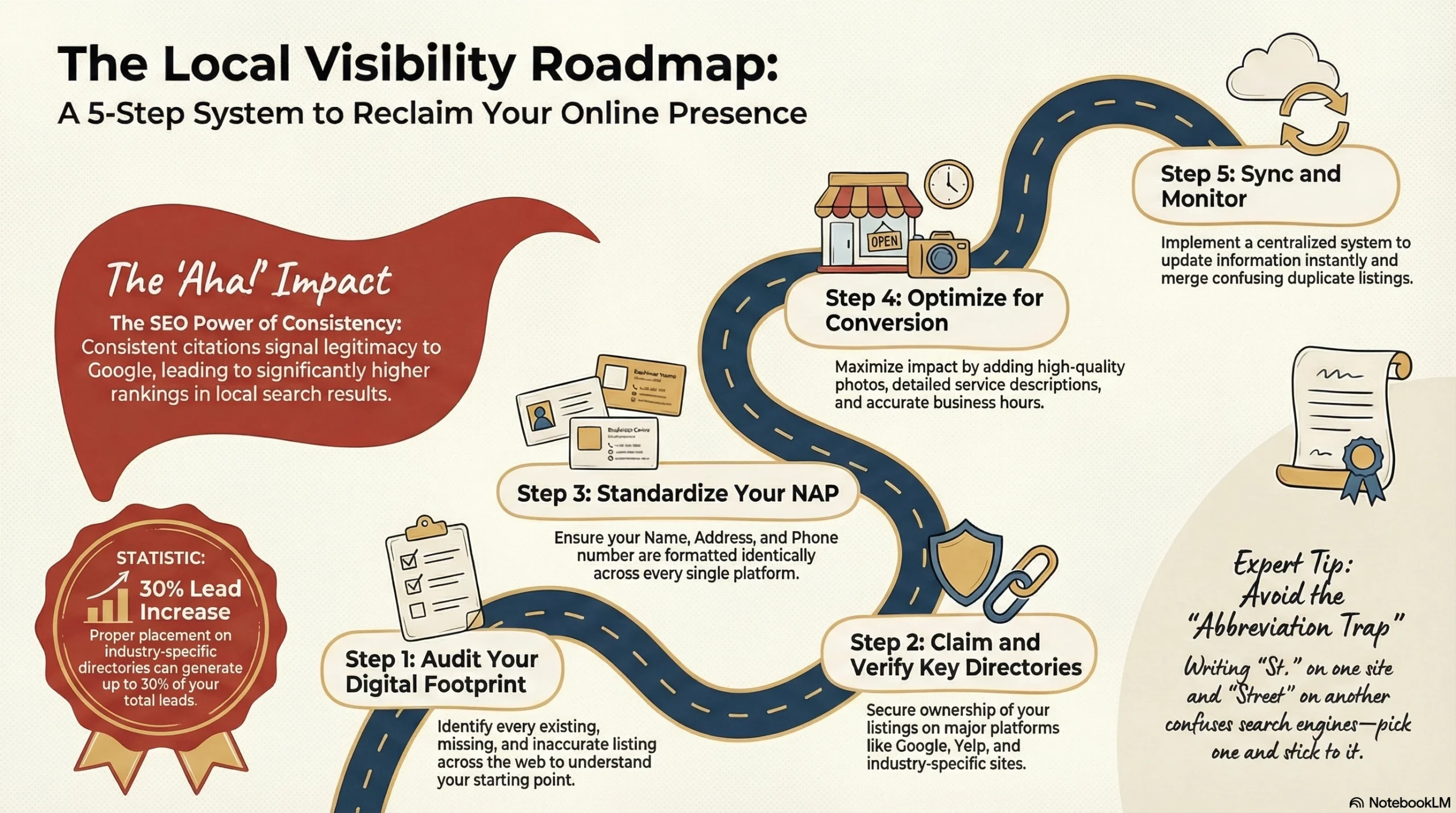
✓ Consistent NAP (Name, Address, Phone) across all directories and citations. (Read more: Why Your Business Is Invisible (And How Online Directories and Citations Fix It).
✓ Basic technical SEO (proper title tags, meta descriptions, header structure, SSL certificate)
✓ Clear, comprehensive service pages that explain what you do and who you serve
✓ Established credibility signals (customer reviews, testimonials, years in business)
If these aren’t solid, fix them first. AI search optimization amplifies a strong foundation, it doesn’t fix a weak one.
This is exactly why the Customer Activity Roadmap exists: to show you the right order to build your marketing so every layer supports the next.
How AI Search Engines Decide What Content to Cite (Understanding the Algorithm)
To optimize for AI search, you need to understand how these systems decide which content to extract and cite.
What AI Search Engines Look For:
- Clear, Direct Answers AI assistants prioritize content that answers questions clearly and concisely at the beginning, then provides additional detail.
- Structured, Scannable Content Content with clear headers, bullet points, numbered lists, and tables is easier for AI to parse and extract.
- Comprehensive Coverage AI favors content that thoroughly addresses a topic, not thin pages with minimal information.
- Expertise and Authority Content that demonstrates genuine expertise, includes specific details, and cites credible sources ranks higher.
- Factual Accuracy AI systems are increasingly sophisticated at identifying and avoiding inaccurate or outdated information.
- Schema Markup Structured data that explicitly tells AI what your content is about and how it’s organized.
- Natural Language Content written conversationally (how people actually speak) performs better for voice search and AI assistants.
- Freshness Recently updated content signals that information is current and relevant.
- Local Relevance For local businesses, content with specific geographic context and local expertise.
- User Engagement Signals While AI doesn’t directly measure this, content that keeps users engaged tends to be more comprehensive and valuable.
The key insight: AI search engines want to provide the BEST answer to users, not just any answer. Your job is to demonstrate that your content is the most authoritative, comprehensive, and helpful source available.

The Complete AI Search Optimization Strategy for Local Businesses
Now let’s get into the specific, actionable steps to optimize your website for AI search engines.
Now let’s get into the specific, actionable steps to optimize your website for AI search engines. For a full breakdown of every technical detail, check out our How to Optimize Your Website for AI Search Engines (The Complete Guide for Small Businesses).
Step 1: Research the Exact Questions Your Customers Are Asking
AI search optimization starts with understanding the specific questions your ideal customers ask.
How to find these questions:
Listen to actual customer conversations:
- What do customers ask during sales calls?
- What questions come up in consultations?
- What do they ask via email or contact forms?
Use AI assistants to research:
- Ask ChatGPT: “What questions do people ask about [your service] in [your area]?”
- Ask Claude: “What are the most common concerns about [your service]?”
- Use voice search: Speak questions into your phone and see what results appear
Check Google’s “People Also Ask” boxes:
- Search for your main services
- Expand all the “People Also Ask” questions
- Note the exact phrasing people use
Use question research tools:
- AnswerThePublic (shows question-based searches)
- AlsoAsked (maps related questions)
- Google Search Console (shows actual queries bringing traffic)
Monitor forums and social media:
- Reddit threads about your industry
- Facebook groups where your customers hang out
- Nextdoor questions in your area
- Industry-specific forums
Example for an HVAC company:
- “Why is my AC not cooling but running?”
- “How often should I replace my air filter?”
- “What size AC unit do I need for a 2000 square foot home?”
- “Should I repair or replace my 15-year-old air conditioner?”
- “How much does AC installation cost in [city]?”
- “What’s the most energy-efficient AC brand?”
Create a question inventory: Document 20-50 questions your customers actually ask, organized by topic and stage of the customer journey.
Step 2: Structure Content with Clear, Direct Answers First
This is the most important AI search optimization technique: Put the direct answer at the very beginning, then elaborate.
The format that works: Question as header (H2 or H3):
How Long Does a Typical Roof Last?
Direct answer (2-3 sentences, 40-60 words): A typical asphalt shingle roof lasts 15-30 years depending on material quality, climate conditions, and maintenance. In [your city], homeowners can expect 20-25 years from quality architectural shingles with proper installation and regular maintenance. Factors like severe weather, ventilation, and attic insulation significantly impact lifespan.
Then expand with detail: [Additional paragraphs providing comprehensive information, specific examples, local context, etc.]
Why this works:
- AI assistants can extract the concise answer for voice responses
- Users get immediate value
- The comprehensive detail demonstrates expertise and authority
- Search engines see both quick answers AND depth
Real example comparison:
Poor structure (AI can’t extract easily): “Roofs are an important investment for homeowners. Many factors go into determining how long they last. Different materials have different lifespans. Weather plays a role. Maintenance matters too. Generally speaking, you can expect your roof to last a while if you take care of it properly…”
Optimized structure (AI-friendly): How long does a roof last? “Most residential roofs last 20-50 years depending on material type. Asphalt shingles (most common) last 15-30 years, metal roofs 40-70 years, and tile roofs 50+ years. Your specific lifespan depends on installation quality, climate, maintenance, and ventilation.
Step 3: Use Structured Formatting That AI Can Easily Parse
AI search engines extract information more easily from well-structured content.
AI-friendly formatting techniques:
Use descriptive headers (H2, H3, H4):
✓ “What causes roof leaks in older homes?”
✓ “How to know if your AC needs repair or replacement”
✓ “Common signs your water heater is failing”
✗ Generic headers like “Overview” or “More Information”
Create scannable bullet points:
✓ One clear point per bullet
✓ Specific, factual information
✓ Parallel structure (all bullets formatted similarly)
Use numbered lists for processes:
- First, turn off power to the unit
- Remove the access panel
- Locate the filter compartment [etc.]
Use bold text for key information:
- Bold important facts, numbers, and key takeaways
- Don’t overuse (reserve for truly important information)
- Bold the direct answer in your opening paragraph
Keep paragraphs concise:
- 2-4 sentences per paragraph
- One main idea per paragraph
- White space makes content scannable
Add definition boxes for technical terms:
SEER Rating: Seasonal Energy Efficiency Ratio – measures air conditioner efficiency. Higher SEER = more efficient. Modern units range from 13-25 SEER.
Step 4: Implement Schema Markup (The Secret Weapon for AI Search)
Schema markup is structured data code that explicitly tells AI search engines what your content is about and how it’s organized.
This is one of the most powerful AI optimization techniques and most businesses completely ignore it.
Key schema types for small businesses:
1. FAQPage Schema Marks up your FAQ sections so AI can extract question-answer pairs directly.
When to use: Any page with multiple questions and answers
Impact: Dramatically increases chances of being cited for question-based searches
2. HowTo Schema Structures step-by-step instructions and processes.
When to use: Guides, tutorials, process explanations
Impact: Gets your content featured in how-to searches and voice assistants
3. LocalBusiness Schema Provides comprehensive information about your business.
When to use: Homepage, about page, contact page
Impact: Helps AI understand your business type, location, services, and credibility
4. Service Schema Describes specific services you offer.
When to use: Individual service pages
Impact: Helps AI match your services to relevant searches
5. Review/Rating Schema Highlights customer reviews and ratings.
When to use: Pages featuring customer testimonials
Impact: Builds trust signals for AI search engines
6. Article Schema Identifies blog posts and articles with metadata.
When to use: All blog content
Impact: Helps AI understand topic, publish date, author expertise
How to implement schema:
Option 1: Use WordPress plugins
- Rank Math SEO
- Yoast SEO
- Schema Pro
- All in One Schema Rich Snippets
Option 2: Use Google’s Structured Data Markup Helper
- Free tool that generates schema code
- Point-and-click interface
- Copy/paste code into your website
Option 3: Work with your web developer
- Provide them with the schema types you need
- They can implement directly in your site code
How to test your schema:
- Use Google’s Rich Results Test tool
- Enter your URL
- See what schema is detected
- Fix any errors identified
Priority implementation:
- Start with FAQPage schema (highest impact for AI search)
- Add LocalBusiness schema (essential for local businesses)
- Implement HowTo schema for process content
- Add Service schema to service pages
- Include Article schema for blog posts
Step 5: Create Comprehensive FAQ Sections
FAQ content is perfectly structured for AI extraction—it’s already in question-and-answer format.
How to create AI-optimized FAQ sections:
Group questions by topic:
- Services
- Pricing
- Process
- Timeline
- Qualifications
- Local considerations
Use the actual question as the header:
How much does roof replacement cost?
(Not: “Pricing Information” or “Cost Details”)
Provide complete, specific answers:
- 50-150 words typically
- Include numbers, timeframes, and specifics
- Add local context
- Address follow-up concerns
Example of well-structured FAQ:
Frequently Asked Questions About AC Repair
How much does AC repair cost?
AC repair in [City] typically costs $150-$600 depending on the issue. Simple fixes like thermostat problems or clogged filters cost $150-$250. Refrigerant recharges run $200-$400. Major component replacements (compressor, evaporator coil) cost $400-$1,500. We provide free diagnostics and detailed estimates before any work begins, so you’ll know exactly what you’re paying for.
How long does AC repair take?
Most AC repairs take 1-3 hours to complete. Simple fixes (filter replacement, thermostat issues) take 30-60 minutes. Standard repairs (capacitor replacement, refrigerant recharge) take 1-2 hours. Major component replacements may take 3-5 hours. We schedule appointments in 2-hour windows and call ahead when we’re on our way.
Should I repair or replace my air conditioner?
Replace your AC if it’s over 15 years old, requires frequent repairs, or needs a major component replacement costing more than 50% of a new unit. Repair if your unit is under 10 years old, the repair is minor, and you’ve maintained it regularly. For units 10-15 years old, we’ll evaluate efficiency, repair cost, and expected remaining lifespan to help you make the most cost-effective decision for your situation.
Then implement FAQPage schema markup on this content so AI search engines can easily extract and cite it.
Step 6: Optimize for Voice Search and Conversational Queries
Voice search queries are longer, more conversational, and question-based—perfect for AI optimization.
Voice search optimization techniques:
Write conversationally:
✓ “How do I know if my water heater needs to be replaced?”
✗ “Water heater replacement indicators”
Target long-tail, question-based keywords:
- Who, what, where, when, why, how questions
- “Should I…” questions
- “What’s the best…” queries
- “How long does…” questions
Include natural language variations:
- “AC” and “air conditioner” and “air conditioning”
- “Furnace” and “heater” and “heating system”
- “Faucet” and “tap” and “fixture”
Optimize for “near me” searches:
- Include your city/region naturally in content
- Create location-specific pages for service areas
- Answer location-specific questions
Provide concise, complete answers:
- Voice assistants typically read 20-30 word responses
- Put the direct answer first
- Make it understandable when read aloud
Use question phrases in your content: Include the actual questions people ask: “Many homeowners ask us, ‘How often should I have my HVAC system serviced?’ The answer is…”
Test your content with voice search:
- Ask Siri, Alexa, and Google Assistant your target questions
- Listen to what answers they provide
- Refine your content based on what you hear
Step 7: Demonstrate Local Expertise and Context
Generic content doesn’t win in AI search. Specific, localized expertise does.
How to add local context:
Include geographic specifics: “In humid climate, AC units work harder than in drier regions, typically reducing lifespan by 2-3 years compared to the national average.”
Address local regulations and requirements: “Requires licensed contractors to pull permits for HVAC replacements. We handle all permitting as part of our service.”
Reference local weather and climate: “Our severe winters put extra strain on heating systems, making annual maintenance especially important.”
Mention local landmarks and neighborhoods: “Serving homeowners for over 15 years.”
Include local pricing context: “While national averages for roof replacement range from $5,000-$12,000, homeowners typically pay $7,000-$10,000 due to local labor costs and building codes.”
Reference local customer concerns: “Many homeowners worry about ice dams during our harsh winters. Here’s how proper attic insulation and ventilation prevent this issue…”
Add local examples and case studies: “Last winter, we helped a family whose furnace failed during the coldest week of the year. Here’s what we did…”
Why local context matters for AI search:
- Differentiates you from generic national content
- Demonstrates genuine expertise in your market
- Helps AI match you to location-specific queries
- Builds trust with local customers
Step 8: Build Topical Authority Through Comprehensive Coverage
AI search engines favor sources that demonstrate comprehensive expertise on a topic.
How to build topical authority:
Cover topics thoroughly, not superficially:
✗ One blog post about “Roof Repair”
✓Comprehensive coverage:
- What causes roof leaks in [climate type] climates?
- How to know if your roof needs repair or replacement
- Different types of roof damage and how to identify them
- Roof repair costs: what to expect
- DIY roof repairs vs. professional service: when to call an expert
- How to choose a roofing contractor
- Roof maintenance tips to prevent future repairs
- Common roofing materials and their repair requirements
- Emergency roof repair: what to do when you have a leak
Create content clusters:
- Main pillar page covering broad topic
- Multiple detailed pages covering specific subtopics
- Internal links connecting related content
Update and expand existing content:
- Add new information as industry changes
- Expand thin content into comprehensive guides
- Update statistics and examples regularly
Answer related and adjacent questions:
- Don’t just answer the main question
- Address follow-up questions customers have
- Cover the entire customer journey
Cite credible sources and data:
- Reference industry standards
- Link to manufacturer specifications
- Include relevant statistics from authoritative sources
- Demonstrate you’re informed by broader industry knowledge
Why topical authority matters: AI search engines recognize when a website comprehensively covers a topic versus having one isolated article. Comprehensive coverage signals expertise and authority.
Specific, localized expertise is what wins citations in AI search. To understand how showing up in Google Maps and local results creates a ripple effect for your business, check out Stop Trying to Compete with Big Brands! Your Secret Weapon is Local SEO.
Step 9: Keep Content Fresh and Factually Accurate
AI search engines prioritize current, accurate information.
Content freshness strategies:
Add publish and update dates:
- Include “Last updated” on all content
- Implement Article schema with datePublished and dateModified
- Regularly review and update older content
Update statistics and examples:
- Replace outdated numbers with current data
- Update pricing information annually
- Refresh examples to reflect current conditions
Add new information as industry evolves:
- New technologies or methods
- Changed regulations or requirements
- Updated best practices
Monitor for factual accuracy:
- Review content for errors or outdated information
- Correct any inaccuracies immediately
- Ensure all technical details are current
Create a content maintenance schedule:
- Quarterly: Review top-performing content for updates needed
- Annually: Comprehensive audit of all content
- Ongoing: Update when industry changes occur
Why freshness matters: AI search engines can detect when content is outdated and will favor more recent, current information. Regular updates signal that your content remains relevant and trustworthy.
Step 10: Monitor How AI Search Engines Are Citing Your Content
You need to know what AI assistants are saying about your business and services.
How to monitor AI search visibility:
Test with AI assistants directly:
ChatGPT:
- “Who are the best companies in your city?”
- “How do I solve problem in your address?”
- “What should I look for when choosing a service provider?”
Claude:
- Ask similar questions
- Note if you’re cited and how you’re described
Google AI Overviews:
- Search for your target questions
- See if you appear in the AI-generated summary
- Note who else is being cited
Voice Search:
- Ask Siri: “What’s the best way to [related to your service]?”
- Ask Alexa: “How much does [your service] cost in [city]?”
- Ask Google Assistant: “Who does [your service] in [city]?”
Perplexity AI:
- Search for your service-related questions
- Check if you’re cited as a source
What to track:
✓ Are you mentioned/cited?
✓ How are you described?
✓ What specific content is being referenced?
✓ Who else is being cited (your competitors)?
✓ What information is the AI providing?
✓ Are there any inaccuracies in what AI says about you?
Create a monitoring schedule:
- Monthly: Test your top 10 target questions across major AI platforms
- Quarterly: Comprehensive audit of AI visibility
- Ongoing: Spot-check when you publish new content
What to do with this information:
- Identify gaps where you’re not being cited
- Create or optimize content to fill those gaps
- Understand what competitors are doing that’s working
- Refine your content based on what AI is extracting

Advanced AI Search Optimization Techniques
Once you’ve implemented the foundational strategies, these advanced techniques can further improve your AI search visibility:
Technique 1: Create “Ultimate Guides” for High-Value Topics
Comprehensive, authoritative guides (2,000-5,000+ words) covering a topic thoroughly tend to dominate AI citations.
Structure:
- Table of contents with jump links
- Multiple sections covering all aspects
- FAQs within the guide
- Visual elements (images, diagrams, tables)
- Clear headers and formatting
- Schema markup throughout
Technique 2: Implement Breadcrumb Navigation
Breadcrumbs help AI understand your site structure and content hierarchy.
Example: Home > Services > HVAC Repair > AC Repair > AC Repair Cost
Implementation:
- Add breadcrumb navigation to all pages
- Implement BreadcrumbList schema markup
- Ensure breadcrumbs reflect logical site structure
Technique 3: Create Video Content with Transcripts
AI can extract information from video transcripts, expanding your visibility.
Strategy:
- Create helpful video content
- Add complete, accurate transcripts to the page
- Include VideoObject schema markup
- Optimize video titles and descriptions
Technique 4: Build Internal Linking with Descriptive Anchor Text
Internal links help AI understand topic relationships and content depth.
Best practices:
- Use descriptive anchor text (not “click here”)
- Link to related, relevant content
- Create logical content pathways
- Include contextual links within content
Technique 5: Optimize for Featured Snippets
Content that appears in Google featured snippets is often used by AI search engines.
How to optimize:
- Identify questions with featured snippets
- Structure content to directly answer the question
- Use lists, tables, or concise paragraphs
- Match the format of existing featured snippets
Common AI Search Optimization Mistakes to Avoid
As you optimize for AI search, watch out for these pitfalls:
Mistake #1: Keyword Stuffing for AI
Some businesses try to “game” AI by stuffing content with questions and keywords.
Why this fails: AI is sophisticated enough to recognize unnatural, over-optimized content.
What to do instead: Write naturally for humans, then structure and format for AI extraction.
Mistake #2: Sacrificing Depth for Brevity
Some businesses create very short content thinking AI only wants quick answers.
Why this fails: AI favors comprehensive, authoritative content. Brief answers are extracted FROM detailed content.
What to do instead: Provide concise answers at the top, then expand with comprehensive detail.
Mistake #3: Ignoring Technical SEO Fundamentals
Focusing only on content while ignoring site speed, mobile optimization, and technical issues.
Why this fails: AI search engines pull from sites that are already technically sound and credible.
What to do instead: Ensure your technical foundation is solid before optimizing content.
Ensure your technical foundation is solid before optimizing content. If your current strategy feels scattered and expensive, it’s time to refocus with Stop Wasting Money! Why That “Quick Fix” Isn’t Growing Your Business.
Mistake #4: Creating Generic, Non-Local Content
Copying national information without adding local context and expertise.
Why this fails: Generic content doesn’t differentiate you or demonstrate local expertise.
What to do instead: Always add specific local context, examples, and expertise to your content.
Mistake #5: Publishing AI-Generated Content Without Human Expertise
Using AI to write content without adding your unique knowledge and perspective.
Why this fails: AI-generated content often lacks the specific expertise and authenticity that builds authority.
What to do instead: Use AI as a drafting tool, then heavily edit to add your expertise, examples, and voice.
Mistake #6: Not Implementing Schema Markup
Creating well-structured content but failing to add schema markup.
Why this fails: You miss the opportunity to explicitly tell AI what your content is about.
What to do instead: Implement relevant schema markup on all optimized content.
Mistake #7: Optimizing Once and Forgetting
Setting up AI optimization but never monitoring, updating, or refining.
Why this fails: AI search evolves, competitors improve, and your content becomes outdated.
What to do instead: Regular monitoring, testing, and content updates.
Measuring AI Search Optimization Success
How do you know if your AI search optimization is working?
Key metrics to track:
AI Citation Frequency:
- How often are you cited by AI assistants for target questions?
- Track monthly across ChatGPT, Google AI Overviews, voice search
Featured Snippet Appearances:
- Are you appearing in Google featured snippets?
- Track position changes over time
Voice Search Visibility:
- What answers do voice assistants provide for your target questions?
- Are you mentioned?
Organic Traffic from Question-Based Queries:
- Google Search Console: filter for question keywords
- Track traffic from “how,” “what,” “why,” “should I” queries
Engagement Metrics:
- Time on page (comprehensive content should increase this)
- Bounce rate (should decrease with better-targeted content)
- Pages per session (good internal linking increases this)
Conversion Rate from AI-Optimized Content:
- Are pages optimized for AI search converting visitors?
- Track leads/calls from these pages
Competitor Comparison:
- Who else is being cited for your target questions?
- Are you gaining or losing share of voice?
Tools for monitoring:
- Google Search Console (traffic and query data)
- Google Analytics (engagement and conversion metrics)
- Manual testing with AI assistants (direct feedback)
- SEO tools like SEMrush or Ahrefs (featured snippet tracking)
Frequently Asked Questions About AI Search Optimization
What’s the difference between SEO and AI search optimization?
Traditional SEO focuses on ranking high in search results to get clicks to your website. AI search optimization (AEO) focuses on being selected as THE answer that AI assistants provide directly to users. You need both: SEO builds your foundation and drives traffic; AEO gets you cited as the authority and captures voice/AI search queries.
Will AI search optimization hurt my traditional SEO rankings?
No. The strategies that work for AI search (comprehensive content, clear structure, schema markup, answering questions) also improve traditional SEO. They’re complementary, not competing approaches.
How long does it take to see results from AI search optimization?
You may see some quick wins (featured snippets, voice search citations) within 2-4 weeks for less competitive queries. Comprehensive AI search visibility typically takes 3-6 months as search engines index your optimized content and recognize your authority. This assumes your foundation is already solid.
Do I need to hire a developer to implement schema markup?
Not necessarily. If you use WordPress, plugins like Rank Math or Yoast can add basic schema markup. For more comprehensive implementation, working with a developer is helpful but not always required. Google’s Structured Data Markup Helper can generate code you can add yourself.
Should I optimize every page on my website for AI search?
Start with your highest-value pages: service pages, top blog posts, and FAQ pages. Prioritize content that answers questions your customers actually ask. Once these are optimized, expand to other content systematically.
How do I know which questions to optimize for?
Research actual customer questions using: (1) conversations with customers, (2) Google’s “People Also Ask” boxes, (3) AI assistants themselves, (4) question research tools like AnswerThePublic, and (5) your Google Search Console data showing what people search for to find you.
Can I just use AI to write all my content for AI search?
No. AI-generated content lacks the specific expertise, local knowledge, and authenticity that builds authority. Use AI as a drafting tool to overcome writer’s block and create structure, but always add your unique expertise, local context, and real examples before publishing.
What if my competitors are already ranking well in AI search?
Good news: Most businesses haven’t optimized for AI search yet. If your competitors are ahead, analyze what they’re doing (ask AI assistants questions and see who’s cited), then create more comprehensive, more locally-specific, better-structured content on the same topics.
Does AI search optimization work for all types of businesses?
Yes, but it’s especially powerful for local service businesses, professional services, healthcare providers, and any business where customers ask questions before making decisions. If your customers use search to find information (not just to find your location), AI search optimization will help you.
How often should I update content optimized for AI search?
Review high-priority content quarterly for updates needed (new information, changed pricing, updated statistics). Conduct a comprehensive audit annually. Update immediately when industry changes occur or you notice inaccuracies in what AI assistants are saying about your services.
What’s the most important AI search optimization technique?
If you can only do one thing: Create comprehensive FAQ pages with clear question headers, complete answers, and FAQPage schema markup. This single technique delivers the highest impact for the least effort.
Your AI Search Optimization Action Plan
Feeling ready to get started? Here’s your step-by-step action plan:
Phase 1: Foundation Check (Week 1)
□ Audit your current website foundation
□ Ensure mobile-friendliness and fast loading speed
□ Verify Google Business Profile is complete
□ Check NAP consistency across directories
□ Confirm basic technical SEO is solid
If your foundation needs work, fix it before proceeding.
Phase 2: Question Research (Week 2)
□ Document 20-50 questions your customers actually ask
□ Organize questions by topic and customer journey stage
□ Prioritize questions based on frequency and business value
□ Research what AI assistants currently say for these questions
□ Identify gaps where you’re not being cited
Phase 3: Content Optimization (Weeks 3-6)
□ Create or optimize FAQ page with top 10-15 questions
□ Implement FAQPage schema markup
□ Optimize 3-5 key service pages with question-answer format
□ Add LocalBusiness schema to homepage
□ Ensure all content has clear headers and structured formatting
Phase 4: Comprehensive Content Creation (Weeks 7-10)
□ Create 2-3 comprehensive guides on high-value topics
□ Implement HowTo schema where applicable
□ Add local context and expertise to all content
□ Build internal linking between related content
□ Optimize for voice search with conversational language
Phase 5: Testing and Refinement (Week 11+)
□ Test target questions with multiple AI assistants
□ Monitor what answers are being provided
□ Track featured snippet appearances
□ Analyze traffic from question-based queries
□ Refine content based on what’s working
Ongoing Maintenance
□ Monthly: Test top questions across AI platforms
□ Quarterly: Review and update high-priority content
□ Annually: Comprehensive content audit
□ Continuously: Monitor competitor AI citations
Your Next Step: Discover Your AI Search Opportunity
You don’t have to figure this out alone.
Want to know exactly how AI search engines currently see your business, and what specific opportunities you’re missing?
We’re offering free AEO (Answer Engine Optimization) audits for businesses who want to understand their current AI search visibility and get a clear roadmap for improvement.
This audit will show you:
- Exactly what AI assistants say when people ask about your services (or if they mention you at all)
- Which competitors are being cited instead of you (and why)
- The biggest gaps in your current content
- Quick wins you can implement immediately
- The specific schema markup you need
- A clear roadmap showing the order to optimize your website
Who this is for:
- Business owners ready to optimize for AI search
- Businesses with a solid foundation ready for the next level
- Business owners who want to stay ahead of competitors
- Anyone frustrated that AI assistants aren’t citing their expertise
Who this is NOT for:
- Businesses without a basic website or online presence
- Those looking for quick fixes without addressing foundation issues
- Anyone not willing to invest in comprehensive, expert content
The shift to AI-powered search is happening right now. Your customers are asking AI assistants questions about the services you provide, every single day.
The question is: Are you the expert being cited, or are you invisible?
Schedule Your Free SEO/AEO Audit Now
At Clay Jar Marketing we’re not just another agency pushing random tactics. We are your marketing partner. We work alongside you to help you scale and grow your business while freeing up your time so that you can focus on what really matters. We’ve walked this path, we understand the struggle, and we’re here to help you succeed. Every potential partnership starts with our comprehensive Playbook consultation, a deep-dive analysis that shows you exactly what to build, in what order, to capture customers at every stage of their journey. Ready to get started?

Sam McKeen