The Critical Importance of Online Reviews for Local Businesses in the AI Search Era
Summary
Online reviews have always mattered for local businesses, but the rise of AI-powered search has fundamentally changed the game. AI doesn’t just read reviews; it interprets them, synthesizes them, and uses them to make recommendations to potential customers. Learn more HERE. For local businesses your online reputation is now the foundation of your entire digital presence. This comprehensive guide explains why reviews matter more than ever, how AI uses them differently than traditional search, and exactly what you need to do to build a reputation that drives predictable customer flow.
Reading time 11 minutes
Introduction: Your Reputation Is Now Your AI Resume
If you’ve built your business on quality work and word-of-mouth referrals, you already understand the power of reputation. But here’s what’s changed: that reputation needs to live online in a format that AI can understand and recommend. Learn more HERE
When someone asks an AI assistant “Who’s the best electrician near me?” or “I need a reliable contractor in Concord, NH,” the AI doesn’t just return a list of websites. It analyzes reviews, synthesizes feedback, identifies patterns, and makes specific recommendations; often naming just one or two businesses.
If your online reputation isn’t strong, you’re invisible to these AI-powered recommendations, even if you’re the best at what you do.
This isn’t about vanity metrics or collecting stars. It’s about ensuring that when potential customers are actively searching for your services right now, AI systems confidently recommend your business instead of your competitors.
Why AI Search Changes Everything About Online Reviews
Traditional Search vs. AI-Powered Search
Traditional Search (Google, Bing):
- Returns a list of options
- Users click through multiple websites
- Reviews are one factor among many
- Customers do their own comparison
AI-Powered Search (ChatGPT, SGE, Bing Chat):
- Provides direct answers and specific recommendations
- Often names 1-3 businesses, not 10+
- Heavily weighs review content and patterns
- Synthesizes reputation into recommendations
- Customers trust AI to pre-filter options
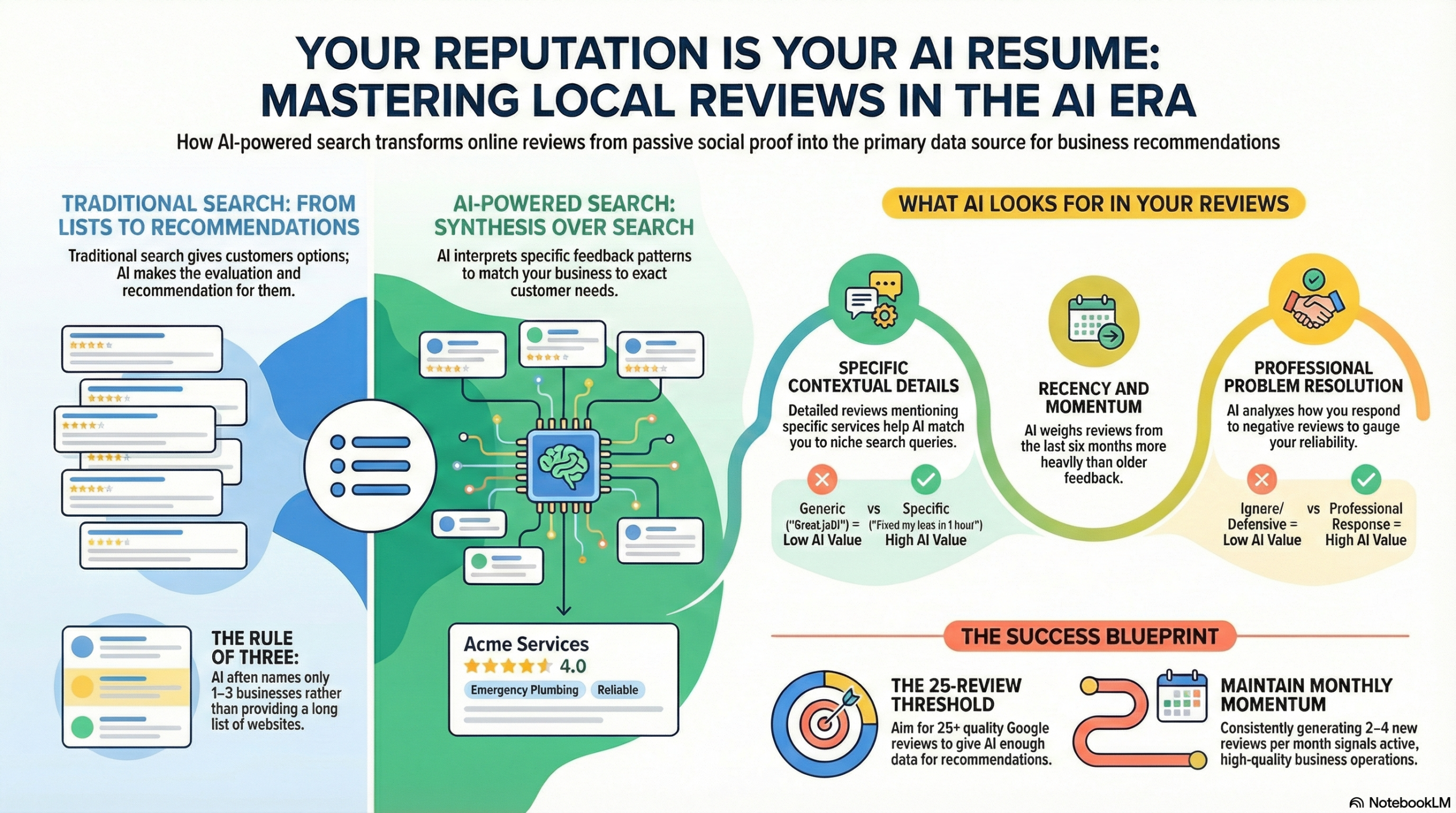
The difference is profound: traditional search gives customers options to evaluate. AI search makes the evaluation for them, and reviews are the primary data source for that evaluation.
How AI Interprets Your Reviews Differently
AI doesn’t just count stars, it reads and understands the actual content of your reviews. Here’s what it’s looking for:
Consistency of Feedback: AI identifies patterns in what customers consistently mention. If fifteen reviews mention “showed up on time” and “explained everything clearly,” AI understands these are your reliable strengths.
Specific Details: Generic reviews (“Great service!”) carry less weight than specific ones (“Joe diagnosed the problem in 10 minutes and had it fixed within the hour, saving us hundreds”). AI uses specifics to match businesses to customer needs.
Problem Resolution: AI analyzes how you respond to negative reviews. Businesses that professionally address concerns demonstrate reliability, which AI factors into recommendations.
Recency and Momentum: AI weighs recent reviews more heavily and recognizes businesses with consistent, ongoing positive feedback versus those with outdated or sporadic reviews.
Contextual Relevance: When someone asks AI for a “family-friendly restaurant” or “emergency plumber,” it searches review content for those specific contexts and matches accordingly.
Why Reviews Are Vital For A Strong Marketing Foundation
Reviews Amplify Your Referrals
When someone refers your business, the first thing that a potential customer does is search for you online. What they find in those first 30 seconds determines whether they call you or keep looking.
A strong review profile converts referrals into customers. A weak one (or worse, no online presence) sends referrals to competitors.
Reviews Capture Active Searchers
Active searchers are people looking for your services right now. They’re typing “contractor near me” or asking AI “who can help with my kitchen renovation?”
These are the highest-value potential customers; they have a need, they’re ready to hire, and they’re actively searching. If your review profile doesn’t capture them, you’re leaving money on the table every single day.
Reviews Build Trust Before the First Conversation
By the time a potential customer contacts you, they’ve already formed an opinion based on your reviews. Strong reviews mean they’re calling to hire you, not to vet you. Weak reviews mean you’re starting from a position of skepticism.
This is especially critical for business owners who are uncomfortable with “selling.” When your reviews do the trust-building for you, conversations become easier and close rates improve dramatically.
The AI Advantage: How to Build a Review Profile That AI Recommends
Quantity Matters
You don’t need hundreds of reviews, but you do need enough for AI to identify consistent patterns. Focus on reaching 25+ quality reviews, then maintaining steady momentum.
Quality Trumps Everything
One detailed, specific review is worth ten generic ones. Here’s what makes a review valuable to AI:
Specific Services Mentioned: “Jeff helped us with our kitchen remodel” is better than “great contractor”
Specific Outcomes Described: “Completed the project two days early and $500 under budget” gives AI concrete information to work with
Specific Attributes Highlighted: “Communicated clearly throughout the process” or “cleaned up thoroughly every day” helps AI match you to customer priorities
Context Provided: “We had three young kids at home and they worked around our schedule” helps AI recommend you for similar situations
Recency Creates Momentum
AI interprets recent reviews as a signal of current quality and active business. A business with 50 reviews from 2019 looks less reliable than one with 25 reviews from the past six months.
Goal: Aim for at least 2-4 new reviews per month. This shows AI (and customers) that you’re actively serving clients and maintaining quality.
Response Rate Demonstrates Professionalism
How you respond to reviews, especially negative ones, tells AI (and customers) how you handle problems.
Best Practices:
- Respond to every review, positive and negative
- Thank customers specifically for what they mentioned
- Address negative reviews professionally and offer solutions
- Keep responses genuine, not templated
- Respond within 48 hours when possible
AI recognizes businesses that engage with feedback as more reliable and customer-focused.
Platform Strategy: Where Your Reviews Matter Most
Google Business Profile (Non-Negotiable)
Google remains the dominant search platform, and Google Business Profile reviews are the single most important review source for local businesses.
Why It Matters:
- Google’s own AI prioritizes its own review data
- Other AI systems pull Google reviews as a primary source
- Google Business Profile appears in maps, local search, and AI results
- It’s free and you control your profile
Action Steps:
- Claim and fully optimize your Google Business Profile
- Make Google reviews your primary focus
- Aim for 25+ Google reviews minimum as quickly as possible
- Maintain steady monthly momentum
Industry-Specific Platforms
Depending on your business, platforms like Yelp, Houzz, Angi, or industry-specific review sites may matter.
Strategy:
- Identify the 1-2 platforms your customers actually use
- Don’t spread yourself thin across every platform
- Focus on Google first, then add 1-2 others if relevant
Your Website (Often Overlooked)
Displaying reviews on your website serves multiple purposes:
- Builds trust with visitors who found you through other channels
- Provides fresh, relevant content for search engines
- Gives you control over which reviews to highlight
- Can be structured data that AI can read
The Systematic Approach: Building Your Review Foundation
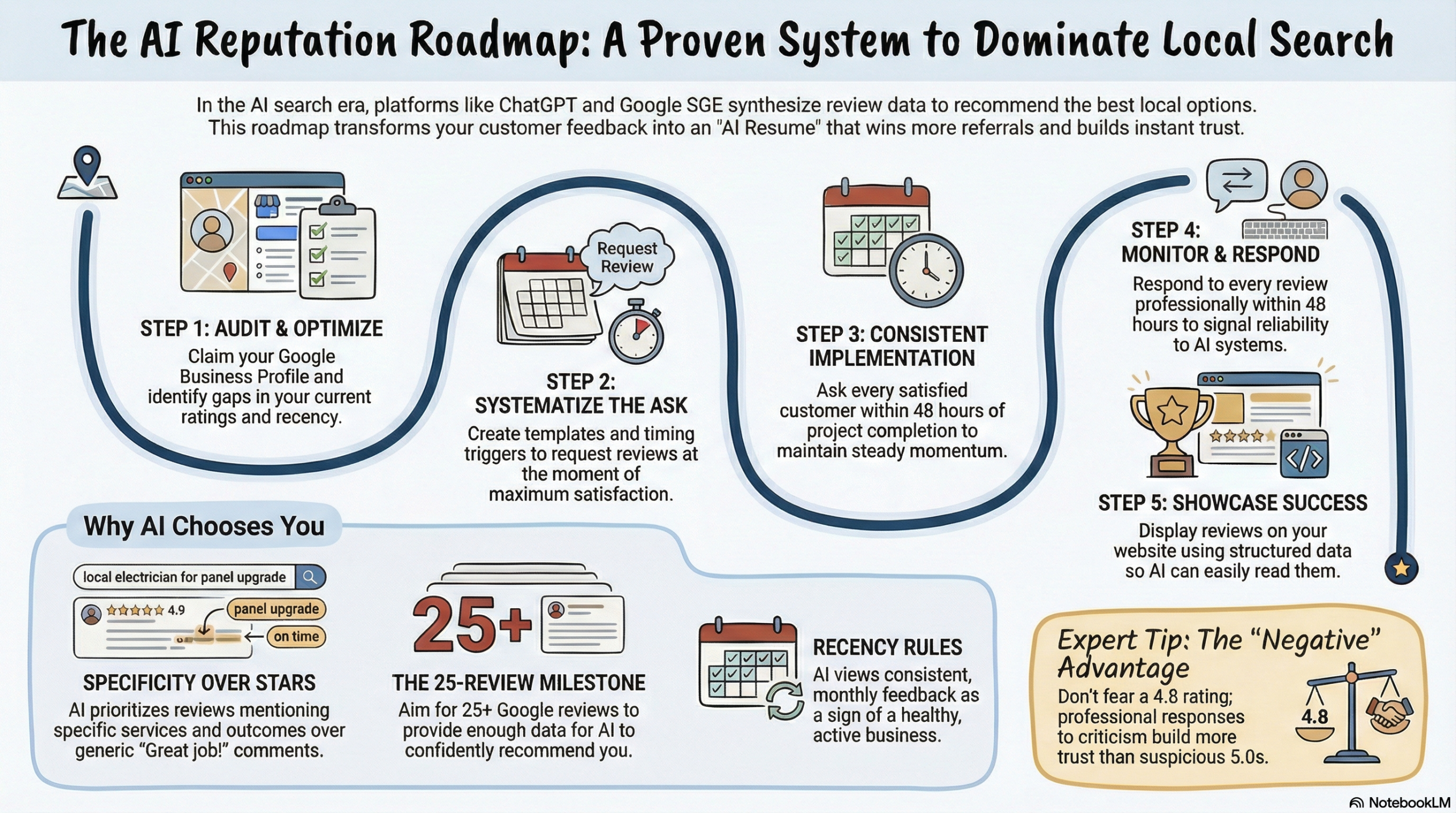
Step 1: Audit Your Current Reputation
What to Do:
- Search your business name on Google
- Check your Google Business Profile
- Review your presence on relevant platforms
- Identify gaps and opportunities
What to Look For:
- Total number of reviews
- Average rating
- Recency of reviews
- Response rate to reviews
- Consistency across platforms
Step 2: Create a Review Generation System
The biggest mistake businesses make is asking for reviews randomly or only when they remember. You need a system.
Timing Matters: Ask for reviews at the moment of maximum satisfaction, typically right after project completion or when a customer expresses appreciation.
Make It Easy:
- Send a direct link to your Google Business Profile review page
- Provide simple, clear instructions
- Reduce friction as much as possible
Sample Request (Email/Text): “Hi Mary, I’m so glad we could help with installing your windows. If you were happy with our work, would you mind sharing your experience in a quick Google review? It really helps other local families find us. Here’s the direct link: [link]. Thanks so much! – Steve”
Step 3: Implement Consistent Asking
Who to Ask:
- Every satisfied customer
- Customers who give verbal praise
- Repeat customers
- Referral sources
When to Ask:
- Ideally within 24-48 hours of project completion
- When customer expresses satisfaction
- After resolving a concern successfully
How Often: Make review requests part of your standard customer journey, not a special occasion.
Step 4: Monitor and Respond
Set up alerts for new reviews and respond promptly. This shows AI and customers that you’re engaged and professional.
Response Template for Positive Reviews: “Thanks so much, Sue! We really enjoyed working on your home. I’m glad we could get your doors replaced. We appreciate your trust and look forward to helping you again in the future!”
Response Template for Negative Reviews: “Thank you for the feedback, Mike . I’m sorry we didn’t meet your expectations with you retaining wall repair. I’d like to make this right. Please contact me directly at [phone/email] so we can discuss how to resolve this. We take every customer’s experience seriously.”
Step 5: Showcase Your Reviews
Don’t hide your reviews, leverage them:
- Display them prominently on your website
- Share positive reviews on social media
- Include testimonials in proposals and presentations
- Reference them in conversations with potential customers

What If I Get a Bad Review?
This is the fear that stops many business owners from actively building their review presence. Let’s address it directly.
The Reality of Negative Reviews
Fact: Every business gets negative reviews eventually. Even the best businesses with 5.0 averages will encounter an unreasonable customer or a legitimate mistake.
What AI Understands: AI systems are sophisticated enough to recognize that a 4.8 rating with 50 reviews is often more trustworthy than a 5.0 with 5 reviews. Perfect ratings can look suspicious.
What Customers Understand: Modern customers are savvy. They read negative reviews to see how you respond and whether the complaint is legitimate or unreasonable.
The Negative Review Response Framework
Step 1: Don’t Panic Take 24 hours before responding if you’re emotional. Never respond defensively.
Step 2: Acknowledge and Apologize Even if you disagree, acknowledge their experience: “I’m sorry you had this experience.”
Step 3: Offer a Solution “I’d like to make this right. Please contact me directly at…”
Step 4: Take It Offline Don’t argue publicly. Move the conversation to private communication.
Step 5: Learn and Improve If the complaint is legitimate, use it to improve your processes.
The Power of Professional Responses
A professionally handled negative review often builds more trust than a glowing positive one. It shows:
- You care about customer satisfaction
- You take responsibility
- You’re willing to make things right
- You’re human and honest
AI recognizes this pattern and often gives more weight to businesses that engage professionally with negative feedback.
The AI Future: What’s Coming and How to Prepare
AI Is Getting More Sophisticated
Future AI systems will:
- Analyze review sentiment with greater nuance
- Identify authentic reviews vs. fake ones more accurately
- Weight recent reviews even more heavily
- Cross-reference reviews with other data sources
- Make increasingly specific recommendations based on customer needs
Voice Search and Conversational AI
As more people use voice assistants and conversational AI, the way they search is changing:
- “Hey Siri, who’s the best plumber near me?”
- “ChatGPT, I need a reliable contractor for my bathroom renovation”
These conversational queries rely heavily on review content to make recommendations.
The Competitive Advantage Window
Right now, many local businesses still don’t understand the importance of reviews in the AI era. This creates an opportunity:
Businesses that build strong review foundations now will dominate AI recommendations for years to come.
The businesses that wait will find themselves invisible to an increasingly large percentage of potential customers.
Common Mistakes That Undermine Your Review Strategy
Mistake #1: Buying Fake Reviews
AI is getting better at detecting fake reviews, and the penalties (both algorithmic and reputational) aren’t worth it. Build your reputation authentically.
Mistake #2: Only Asking Your Best Customers
This creates an unrealistic profile. Ask every satisfied customer, not just your biggest fans.
Mistake #3: Ignoring Negative Reviews
Silence looks worse than the negative review itself. Always respond professionally.
Mistake #4: Asking at the Wrong Time
Asking for reviews months after the project creates friction and reduces response rates. Ask when satisfaction is highest.
Mistake #5: Making It Complicated
Long forms, multi-step processes, or vague instructions kill response rates. Make it as easy as possible.
Mistake #6: Giving Up Too Soon
Building a review foundation takes consistent effort over months, not weeks. Stick with your system.
Mistake #7: Spreading Too Thin
Trying to build reviews on every platform dilutes your efforts. Focus on Google first, then add 1-2 others if relevant.
The Clay Jar Approach: Reviews as Foundation, Not Afterthought
At Clay Jar Marketing we place reviews in the Foundation tier of the Customer Activity Roadmap because everything else builds on them.
Without a strong review foundation:
- Your referrals convert at lower rates
- Active searchers choose competitors
- Your ads and marketing efforts work harder for less return
- AI systems overlook you in favor of better-reviewed competitors
With a strong review foundation:
- Referrals convert more easily
- You capture active searchers consistently
- Your marketing dollars work harder
- AI confidently recommends you
- You have control over your growth trajectory
This isn’t about perfection, it’s about systematic progress. Start where you are, build consistently, and watch your review foundation transform your entire marketing effectiveness.
Action Steps: What to Do Right Now
This Week:
- Audit your current review presence on Google
- Claim and optimize your Google Business Profile if you haven’t
- Identify your 5 most recent satisfied customers
- Send them a review request with a direct link
This Month:
- Create a review request template (email and text)
- Build review requests into your customer journey
- Set up alerts for new reviews
- Respond to all existing reviews you haven’t addressed
- Add review display to your website
This Quarter:
- Aim for 10+ new Google reviews
- Establish a consistent rhythm (2-4 reviews/month)
- Monitor your progress and adjust your approach
- Track how your review profile impacts customer conversations
This Year:
- Build toward 25+ Google reviews minimum
- Maintain consistent monthly momentum
- Expand to 1-2 additional relevant platforms
- Leverage reviews across all marketing materials
Frequently Asked Questions
How many reviews do I really need?
Short answer: Aim for 25+ Google reviews as your initial goal, then maintain momentum with 2-4 new reviews monthly.
Long answer: The exact number depends on your market and competition, but 25 reviews is typically the threshold where AI systems have enough data to confidently recommend you. More importantly than hitting a number, you need consistent, recent reviews that show ongoing quality and active business.
What if I’m starting from zero reviews?
Start by asking your most recent satisfied customers and your best long-term clients. Most business owners are surprised by how willing customers are to help when asked directly. Focus on getting your first 10 reviews within 30 days, then build from there.
Should I incentivize reviews?
Be careful here. Offering discounts or payments for reviews violates most platform policies and can get your profile penalized. However, you can create a culture of feedback by making it easy and expressing genuine appreciation when customers take the time to review. Some businesses successfully run “customer appreciation” programs that aren’t explicitly tied to reviews but create goodwill that naturally leads to more feedback.
How do I respond to a completely unfair negative review?
Stay professional, even when it’s difficult. Acknowledge their experience, offer to discuss offline, and let your professionalism speak for itself. Other potential customers reading the exchange will see how you handle difficult situations. If the review violates platform policies (contains profanity, false information, etc.), you can flag it for removal, but don’t count on it being taken down.
What’s the best way to ask for reviews without seeming pushy?
Timing and framing matter. Ask at the moment of maximum satisfaction, frame it as helping other customers find you (not helping yourself), make it easy with a direct link, and be genuinely appreciative. Most customers are happy to help if you’ve done good work and you make it simple.
Do reviews on my website help with AI search?
Yes, if structured properly. Use schema markup to help AI systems read and understand your website reviews. However, third-party reviews (especially Google) carry more weight because they’re verified and harder to fake. Display both: third-party reviews for credibility and website testimonials for control over presentation.
How long does it take to build a strong review foundation?
With a consistent system, most businesses can reach 25+ Google reviews within a couple of months. The key is consistency, asking every satisfied customer, making it easy, and maintaining momentum. Businesses that ask sporadically might take years to reach the same threshold.
What if my competitors have hundreds of reviews and I’m just starting?}
Focus on quality and recency. A business with 30 recent, detailed reviews often outperforms one with 200 old, generic reviews. AI weighs recency and specificity heavily. You’re not trying to match their total, you’re trying to show consistent, current quality.
Should I focus on Google reviews exclusively?
Google should be your primary focus because it’s the most important platform for local search and AI recommendations. Once you have a strong Google foundation (25+ reviews, consistent momentum), you can expand to 1-2 other platforms if they’re relevant to your industry. Don’t spread yourself thin across every platform.
How do I handle a customer who threatens a bad review?
Stay calm and professional. Listen to their concerns, take them seriously, and focus on resolving the underlying issue rather than the review threat. Often, customers who feel heard and see genuine effort to make things right will either not leave the review or will update it positively. If they do leave a negative review, your professional response will demonstrate your character to future customers.
Can I delete or hide negative reviews?
On most platforms, no. You can flag reviews that violate policies, but you can’t simply delete reviews you don’t like. This is actually a good thing, it keeps review systems trustworthy. Instead of trying to hide negative reviews, focus on responding professionally and generating enough positive reviews that they’re put in proper context.
What’s the difference between reviews and testimonials?
Reviews are third-party verified feedback on platforms like Google. Testimonials are customer feedback you collect and display yourself. Both matter, but reviews carry more weight because they’re harder to fake. Use testimonials on your website and marketing materials, but prioritize building genuine third-party reviews.
How does AI tell the difference between real and fake reviews?
AI systems analyze patterns: review timing, reviewer history, language patterns, IP addresses, and consistency with other data. They’re getting increasingly sophisticated at detecting fake reviews. This is why buying reviews is a terrible strategy—you risk penalties and reputation damage.
Do review responses really matter?
Yes, significantly. AI systems recognize businesses that engage with reviews as more customer-focused and reliable. Your responses also provide additional context and keywords that AI can analyze. Plus, potential customers read your responses to gauge your professionalism and customer service approach.
What if I get a negative review from someone who was never actually a customer?
Flag it through the platform’s reporting system. Most platforms will remove reviews from non-customers if you can demonstrate they never did business with you. Document your case clearly and be patient with the review process.
Conclusion: Your Reputation Is Your Foundation
The rise of AI search hasn’t changed the fundamental truth that reputation matters, it’s amplified it exponentially.
Your online reviews are no longer just social proof. They’re the data that AI systems use to decide whether to recommend your business to potential customers actively searching for your services right now.
For business owners who’ve built their reputation on quality work and word-of-mouth referrals, this is actually good news. You already have the hardest part, satisfied customers. Now you just need a system to capture that satisfaction in a format that AI can understand and recommend.
This isn’t about gaming the system or being salesy. It’s about ensuring that the quality work you’re already doing gets the visibility it deserves in an AI-powered world.
Start with your foundation. Build your review presence systematically. And watch as your marketing gets easier, your customer flow gets more predictable, and your business gets the recognition it deserves.
The businesses that build strong review foundations now will dominate AI recommendations for years to come. Will yours be one of them?
Ready to Build Your Review Foundation?
Reviews are just one piece of the Foundation tier in the Customer Activity Roadmap, but they’re a critical piece that too many businesses leave to chance.
At Clay Jar Marketing, we don’t just tell you reviews matter. We help you build a system that generates them consistently. Learn more HERE
Our review generation service takes the guesswork and inconsistency out of building your online reputation. We create customized systems that fit naturally into your customer journey, making it easy to collect authentic reviews from satisfied customers without the awkwardness or hassle. Learn more about our reviews and reputation service.
But reviews are just the beginning. If you’re ready to understand exactly how to build marketing systematically, schedule your free Clay Jar Marketing Playbook consultation.
We’ll evaluate your current online presence, identify your biggest opportunities, and create a customized marketing roadmap.
Schedule Your Free Playbook Consultation Today
At Clay Jar Marketing we’re not just another agency pushing random tactics. We are your marketing partner. We work alongside you to help you scale and grow your business while freeing up your time so that you can focus on what really matters. We’ve walked this path, we understand the struggle, and we’re here to help you succeed. Every potential partnership starts with our comprehensive Playbook consultation, a deep-dive analysis that shows you exactly what to build, in what order, to capture customers at every stage of their journey. Ready to get started?

Sam McKeen