If you’ve been paying attention to how people search for information online, you’ve probably noticed something changing.
People aren’t just typing keywords into Google anymore. They’re asking full questions to Siri, Alexa, and ChatGPT. They’re getting instant answers without ever clicking a website link. They’re using AI assistants that give them direct responses instead of a list of links.
Welcome to the era of Answer Engine Optimization (AEO)—and if you’re still only thinking about traditional SEO, you’re missing a massive opportunity to get found by your ideal customers.
But here’s what most businesses don’t understand: AEO isn’t a replacement for SEO. It’s the next layer you build on top of a solid SEO foundation. And just like with AI SEO, if you try to jump straight to AEO without building the foundation first, you’ll waste time and money with nothing to show for it.
Let me show you exactly what AEO is, why it matters for your business, an most importantly where it fits in your marketing roadmap so you can use it strategically instead of chasing another shiny tactic.
What Exactly Is Answer Engine Optimization (AEO)?
Let’s start with a simple definition.
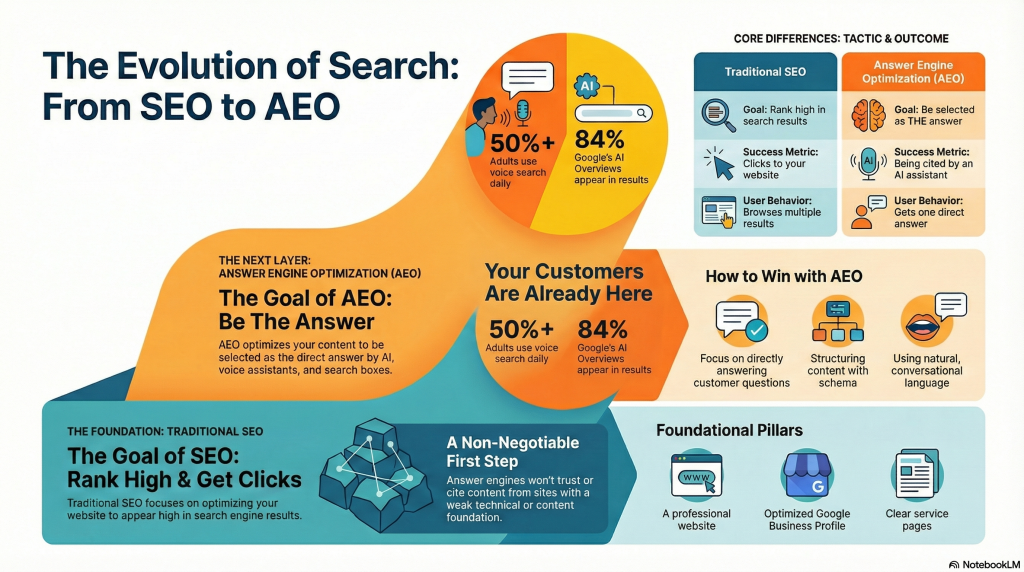
Answer Engine Optimization (AEO) is the practice of optimizing your content to be selected as the direct answer by AI assistants, voice search devices, and search engine answer boxes.
Instead of optimizing to rank #1 in search results, you’re optimizing to BE the answer that gets spoken by Siri, displayed by ChatGPT, featured in Google’s AI Overview, or read aloud by Alexa.
Think about how search behavior has evolved:
Traditional SEO (2010s):
- User types: “plumber near me”
- Google shows multiple results
- User clicks and browses websites
- User finds answer on your site
Answer Engine Optimization (2020s):
- User asks: “Why is my water heater making a banging noise?”
- AI assistant gives direct answer (pulled from YOUR content)
- User gets answer immediately
- User contacts you because you demonstrated expertise
See the difference?
With AEO, you’re not trying to get people to click to your website to find the answer. You’re trying to get the AI to use YOUR content as the authoritative source for the answer, positioning you as the expert before the customer even visits your site.

Why AEO Matters for Local Businesses Right Now
You might be thinking, “This sounds complicated. Do I really need to worry about this?”
Here’s why you should care:
1. Your Customers Are Already Using Answer Engines
- Voice search is used by over 50% of adults daily
- ChatGPT has over 100 million weekly active users
- Google’s AI Overviews now appear in 84% of search results
- Voice assistants (Alexa, Siri, Google Assistant) answer questions without showing traditional search results
Your customers aren’t waiting for you to adopt AEO. They’re already asking AI assistants questions about the services you provide—right now.
2. Answer Engines Are Changing How Customers Find Local Businesses
When someone asks their phone, “Who’s the best HVAC company near me?” or “How do I know if I need a new roof?”, the AI assistant gives ONE answer, not ten options.
If your content isn’t optimized for AEO, you’re invisible in these searches. Someone else is getting that customer.
3. AEO Builds Trust Before the Customer Contacts You
When an AI assistant uses your content to answer a question, you’re instantly positioned as the expert. The customer hasn’t even visited your website yet, but they already trust you because you provided the answer they needed.
This is especially powerful for local businesses built on reputation and expertise.
4. Your Competitors Probably Aren’t Doing This Yet
Most businesses are still figuring out basic SEO. Very few have optimized for answer engines. This is your opportunity to get ahead while the window is still open.
The Biggest AEO Mistake Businesses Make
Before we talk about how to do AEO right, let’s address the mistake that wastes the most time and money:
Trying to optimize for answer engines before building a solid SEO foundation.
I see this constantly. A business owner hears about AEO, gets excited, and immediately tries to optimize their content for AI assistants, without first ensuring their:
- Website is technically sound and mobile-friendly
- Google Business Profile is fully optimized
- Core service pages clearly explain what they do
- Content answers customer questions comprehensively
- Local SEO foundation is solid
What happens?
They spend time creating “AEO-optimized” content that gets ignored by answer engines because the foundation isn’t there to support it.
This is exactly why the Customer Activity Roadmap exists, to show you the right order to build your marketing so every layer is supported by what came before it.
Where AEO Fits in Your Marketing Strategy
Let’s be crystal clear about where Answer Engine Optimization belongs in your marketing journey:
Build This FIRST (Before AEO)
Before you worry about optimizing for AI assistants, you need:
- A professional, mobile-friendly website with clear messaging about what you do and who you serve
- Fully optimized Google Business Profile with complete information, categories, and regular posts
- Strong on-page SEO (proper title tags, meta descriptions, header structure, schema markup)
- Clear, comprehensive service pages that explain your offerings in detail
- Customer reviews and testimonials that build credibility
Why this matters for AEO: Answer engines pull information from websites that are already trusted and well-structured. If your foundation is weak, AI assistants won’t consider your content authoritative enough to cite.
What to do at this stage: Focus on technical SEO, clear messaging, and building trust signals. Get your Google Business Profile perfect. Make sure your website clearly communicates your expertise.
Where AEO Becomes Powerful
Once your foundation is solid, you’re ready to capture people actively searching for your services. This is where AEO starts delivering serious results.
At this stage, you need:
- Question-focused content that directly answers what your customers are asking
- Structured, comprehensive answers formatted for easy extraction by AI
- Local expertise demonstrated through specific, detailed content
- Schema markup that helps answer engines understand your content
- FAQ sections that address common customer questions
This is the sweet spot for AEO.
Why? Because you’ve already built the foundation of trust and authority. Now you’re creating content specifically designed to be selected by answer engines—and you have the credibility to back it up.
What to do at this stage:
- Research the exact questions your customers ask (more on this below)
- Create comprehensive, structured answers using proper formatting
- Implement schema markup to help AI understand your content
- Optimize for featured snippets and AI overviews
- Structure content for voice search with natural language

Passive Searchers Tier: AEO as a Scaling Tool
Once you’re capturing active searchers through AEO, you can expand to reach future customers who aren’t yet looking for your services.
At this stage, you might use AEO to:
- Create educational content that positions you as the go-to expert
- Answer adjacent questions that introduce people to services they didn’t know they needed
- Build topical authority across your entire industry
- Dominate voice search for a wide range of related queries
But remember, this only works if the previous tiers are solid.
The Practical AEO Strategy for Local Businesses
So how do you actually optimize for answer engines? Here’s the step-by-step approach:
Step 1: Identify the Questions Your Customers Are Actually Asking
AEO starts with understanding the exact questions your ideal customers ask. Not the keywords they type, the full questions they speak or ask AI assistants.
How to find these questions:
- Listen to your actual customers: What do they ask during sales calls? What questions come up repeatedly?
- Check “People Also Ask” boxes in Google search results for your services
- Use tools like AnswerThePublic to see question-based searches in your industry
- Ask AI assistants what questions people ask about your services
- Review your customer service emails for common questions
- Look at Google Search Console for question-based queries bringing traffic
Example for a roofing company:
- “How do I know if my roof needs to be replaced?”
- “What causes roof leaks in older homes?”
- “How long does a typical roof last?”
- “Should I repair or replace my roof?”
- “What’s the best roofing material for [your climate]?”
Step 2: Create Comprehensive, Structured Answers
Once you know the questions, create content that answers them completely and clearly.
AEO content best practices:
Use clear, direct answers at the beginning:
Question: “How long does a typical asphalt shingle roof last?”
Direct answer (first 2-3 sentences): “A typical asphalt shingle roof lasts 15-30 years depending on quality, climate, and maintenance. In [your area], homeowners can expect 20-25 years from quality architectural shingles with proper installation and regular maintenance.”
Structure content with clear headers:
- Use H2 and H3 tags to organize information
- Create scannable sections that AI can easily parse
- Use descriptive headers that match question formats
Include specific, factual information:
- Numbers, timeframes, and specific details
- Local context and regional considerations
- Step-by-step processes when relevant
Format for easy extraction:
- Use bullet points and numbered lists
- Keep paragraphs concise (2-4 sentences)
- Bold key information
- Use tables for comparisons
Step 3: Implement Schema Markup
Schema markup is code that helps answer engines understand your content structure and context.
Key schema types for local businesses:
- FAQ Page schema: Marks up your FAQ sections so answer engines can extract Q&A pairs
- How To schema: Structures step-by-step instructions
- Local Business schema: Provides detailed business information
- Service schema: Describes your specific services
- Review schema: Highlights customer testimonials
Why this matters: Answer engines prioritize content with proper schema because it’s easier to understand and extract.
What to do: Work with your web developer or use schema plugins to implement relevant markup on your key pages.
Step 4: Optimize for Voice Search
Voice search queries are conversational and question-based, perfect for AEO.
Voice search optimization tips:
Use natural, conversational language:
- Write how people actually speak, not how they type
- Include question phrases in your content
- Use long-tail, conversational keywords
Target question-based queries:
- Who, what, where, when, why, how questions
- “Near me” searches for local businesses
- Comparison questions (“Should I… or…?”)
Provide concise, complete answers:
- Voice assistants typically read 20-30 word answers
- Put the direct answer first, then elaborate
- Be specific and factual
Optimize for local voice search:
- Include your city/region in content naturally
- Answer location-specific questions
- Optimize Google Business Profile (voice assistants pull from this)
Step 5: Create Dedicated FAQ Pages and Sections
FAQ content is AEO gold. It’s already in question-and-answer format, which is exactly what answer engines want.
How to create AEO-optimized FAQs:
- Group questions by topic (services, pricing, process, etc.)
- Use the actual question as the header (H2 or H3)
- Provide clear, complete answers (50-150 words typically)
- Include local context where relevant
- Add FAQ schema markup to help answer engines extract the content
- Update regularly based on new customer questions
Step 6: Monitor What Answer Engines Are Saying About Your Services
You need to know what answers AI assistants are currently giving when people ask questions about your services.
How to monitor:
- Ask AI assistants directly: Ask ChatGPT, Claude, Google, Siri, and Alexa questions your customers would ask
- Check Google’s AI Overviews: Search for your target questions and see what appears in the AI-generated summary
- Use voice search: Speak questions into your phone and see what answers you get
- Monitor featured snippets: See who’s currently getting featured for your target questions
What to look for:
- Are you being cited as a source?
- Who is being cited instead?
- What information is being provided?
- Are there gaps or inaccuracies you can address?
Step 7: Build Topical Authority
Answer engines favor sources that demonstrate comprehensive expertise on a topic.
How to build topical authority:
- Cover topics comprehensively: Don’t just write one article about roof replacement—cover every aspect (materials, process, cost, timeline, maintenance, repairs, etc.)
- Interlink related content: Connect your articles so answer engines see the depth of your expertise
- Update content regularly: Keep information current and add new insights
- Cite credible sources: Reference industry standards, manufacturers, and authoritative data
- Demonstrate local expertise: Include specific information about your market, climate, regulations
AEO vs. SEO: Understanding the Difference (And Why You Need Both)
Let’s clear up the confusion between Answer Engine Optimization and traditional SEO:
| Traditional SEO | Answer Engine Optimization (AEO) |
| Goal: Rank high in search results | Goal: Be selected as THE answer |
| Success: Getting clicks to your website | Success: Being cited by AI assistants |
| Format: Optimized for ranking algorithms | Format: Optimized for answer extraction |
| User behavior: Browses multiple results | User behavior: Gets one direct answer |
| Metrics: Rankings, traffic, click-through rate | Metrics: Featured snippets, voice search results, AI citations |
The key insight: You need both.
- SEO gets you found and drives traffic to your website
- AEO positions you as the authoritative source and gets you cited by AI
They work together. Your SEO foundation makes your content credible enough for answer engines to trust. Your AEO optimization makes your content easy for AI to extract and cite.
Common AEO Mistakes to Avoid
As you implement Answer Engine Optimization, watch out for these pitfalls:
Mistake #1: Skipping the SEO Foundation
AEO doesn’t work without solid SEO fundamentals. Answer engines pull from websites that are already trusted and well-optimized.
What to do instead: Build your foundation first (technical SEO, Google Business Profile, core content), then layer AEO on top.
Mistake #2: Writing for AI Instead of Humans
Some businesses create robotic, overly-structured content trying to please answer engines—and it reads terribly.
What to do instead: Write naturally for humans first, then structure and format for AI extraction. Your expertise and authentic voice still matter.
Mistake #3: Ignoring Local Context
Generic answers don’t win in answer engines. Specific, localized expertise does.
What to do instead: Include local details, regional considerations, and specific examples from your market. This makes your content more valuable AND more likely to be selected for local searches.
Mistake #4: Focusing Only on Short Answers
Yes, answer engines often pull brief excerpts—but they pull them from comprehensive, authoritative content.
What to do instead: Provide a concise direct answer at the top, then expand with detailed information. Depth and comprehensiveness build authority.
Mistake #5: Not Implementing Schema Markup
Schema markup is one of the most powerful AEO tools, yet most local businesses ignore it.
What to do instead: Implement relevant schema markup on your key pages, especially FAQ and service pages. This dramatically increases your chances of being selected by answer engines.
Mistake #6: Creating Content Without Researching Actual Questions
Don’t guess what questions people are asking. Find out.
What to do instead: Research actual customer questions using the methods outlined above. Create content that answers real questions, not what you think people might ask.
Real-World AEO for local Businesses: A Practical Example
Let’s say you own a local HVAC company. Here’s how you might implement AEO strategically:
Foundation (Do This First):
- Ensure your website is mobile-friendly, fast, and technically sound
- Fully optimize your Google Business Profile with complete information
- Create clear service pages for AC repair, installation, maintenance, etc.
- Implement LocalBusiness schema markup
- Build initial credibility with customer reviews
- Accurate, consistent business listings across major directories
- Strong citation profile that verifies your business
Active Searchers (AEO Implementation):
Research questions:
- “Why is my AC not cooling?”
- “How often should I replace my AC filter?”
- “How long does an AC unit last?”
- “Should I repair or replace my air conditioner?”
- “What size AC unit do I need for a [square footage] home?”
Create comprehensive FAQ page:
- Use actual questions as headers
- Provide clear, specific answers (including local climate considerations)
- Implement FAQPage schema markup
- Include local expertise and examples
Create detailed how-to content:
- “How to Know If Your AC Needs Repair or Replacement”
- “Complete Guide to AC Maintenance in [Your Climate]”
- Structure with HowTo schema markup
- Use clear steps and specific details
Optimize for voice search:
- Include conversational question phrases
- Provide concise answers at the beginning
- Add local context naturally
Monitor and refine:
- Ask voice assistants your target questions
- Check if you’re being cited
- Identify gaps and create additional content
The result? When someone in your area asks their phone, “Why isn’t my AC cooling?” the AI assistant pulls the answer from YOUR content—positioning you as the expert before they even call.

The Future of Answer Engines (And What It Means for Your Business)
Answer Engine Optimization isn’t a passing trend. It’s the future of how people find information and businesses.
What’s coming:
- More AI-powered search: Google, Bing, and other search engines are integrating AI overviews as the primary result format
- Expanded voice search: Smart speakers, car systems, and wearables will increase voice query volume
- AI shopping assistants: AI will recommend businesses based on expertise demonstrated through content
- Conversational search: Multi-turn conversations with AI assistants will become the norm
What this means for local businesses:
- Being findable means being cite-able: It’s not enough to rank—you need to be the source AI trusts and references
- Expertise becomes measurable: Answer engines will increasingly favor businesses that demonstrate comprehensive, accurate expertise
- Local knowledge is your advantage: Generic content won’t cut it. Specific, localized expertise will win
- The foundation matters more than ever: Answer engines pull from credible, well-structured sources. Weak foundations mean invisibility.
Should You Invest in AEO Right Now?
Yes—if you’ve built the foundation first.
Answer Engine Optimization is powerful, and early adopters have a significant advantage. But it only works when layered on top of solid SEO fundamentals.
Here’s how to know if you’re ready for AEO:
✅ You’re ready if:
- Your website is professional, mobile-friendly, and technically sound
- Your Google Business Profile is fully optimized and active
- You have clear, comprehensive service pages
- Your basic on-page SEO is solid
- You’re creating content regularly
- You want to capture voice search and AI-powered queries
❌ You’re NOT ready if:
- Your website is outdated or poorly structured
- Your Google Business Profile is incomplete
- You don’t have clear content about your services
- Your technical SEO has major issues
- You’re not sure what your customers are actually searching for
The bottom line: AEO is the next evolution of search, and local businesses that optimize for answer engines now will dominate local search in the coming years. But it must be built on a solid foundation, implemented strategically, and aligned with the Customer Activity Roadmap.
Your Next Step: Get Your Free AEO Audit
Want to know if your website is optimized for answer engines—and what opportunities you’re missing?
We’re offering free AEO audits for local business owners who want to understand their current visibility in AI-powered search.
In your free AEO audit, we’ll:
✓ Analyze how answer engines currently see your business (what they’re saying when people ask questions about your services)
✓ Identify the questions your customers are asking that you should be answering
✓ Evaluate your content structure and schema markup for AEO readiness
✓ Assess your foundation to ensure you’re ready for AEO implementation
✓ Show you specific opportunities to get cited by AI assistants and voice search
✓ Provide a clear roadmap showing exactly what to optimize and in what order
This audit will show you:
- Whether your business appears when AI assistants answer questions about your services
- What your competitors are doing that you’re missing
- Quick wins you can implement immediately
- Where AEO fits in your overall marketing strategy
Who this is for:
- Local business owners who want to stay ahead of search evolution
- Businesses with a solid website foundation ready for the next level
- Local service providers who want to dominate voice search
- Business owners frustrated that competitors are getting found while they’re invisible
Who this is NOT for:
- Businesses without a basic website or online presence
- Those looking for quick fixes without strategy
- Anyone not willing to invest in building marketing the right order
The shift to answer engines is happening right now. Your customers are already asking AI assistants questions about the services you provide.
The question is: Are you the expert being cited, or are you invisible?
Ready to stop being invisible and start being the answer? Schedule your free AEO audit and get your customized roadmap showing exactly how to optimize for answer engines, in the right order, with the right strategy.
About Clay Jar At Clay Jar Marketing we’re not just another agency pushing random tactics. We are your marketing partner. We work alongside you to help you scale and grow your business while freeing up your time so that you can focus on what really matters. We’ve walked this path, we understand the struggle, and we’re here to help you succeed. Every potential partnership starts with our comprehensive Playbook consultation, a deep-dive analysis that shows you exactly what to build, in what order, to capture customers at every stage of their journey.