
Why Email Marketing Still Works And Why You Can’t Afford to Ignore It
Summary
In an era of social media algorithms and AI chatbots, email marketing remains one of the most powerful tools for local businesses, yet most underestimate or abandon it. This article reveals why email isn’t dead (it’s more valuable than ever), how it fits into your authority-building system, and why businesses that master email nurture turn one-time visitors into long-term customers. Learn the real reason email outperforms social media, what makes email effective and how to use it without feeling salesy or annoying.
Reading Time: 10 minutes
The Marketing Channel Everyone Thinks Is Dead
“Email marketing? Isn’t that… outdated?”
I hear this constantly from local business owners. They’ve been told email is dead. That nobody reads emails anymore. That social media and AI are the future.
Meanwhile, the most successful local businesses I work with have one thing in common: they use email systematically to stay unforgettable.
Here’s the uncomfortable truth: If you’re not using email marketing, you’re invisible to 90% of your potential customers between the moment they discover you and the moment they’re ready to buy.
Let me show you why email isn’t just alive, it’s the most underutilized authority-building tool available to local businesses today.
The Invisible Problem: The Gap Between Discovery and Decision
Think about your own buying behavior for a moment.
How often do you discover a business, think “That’s interesting,” and then immediately buy?
Almost never.
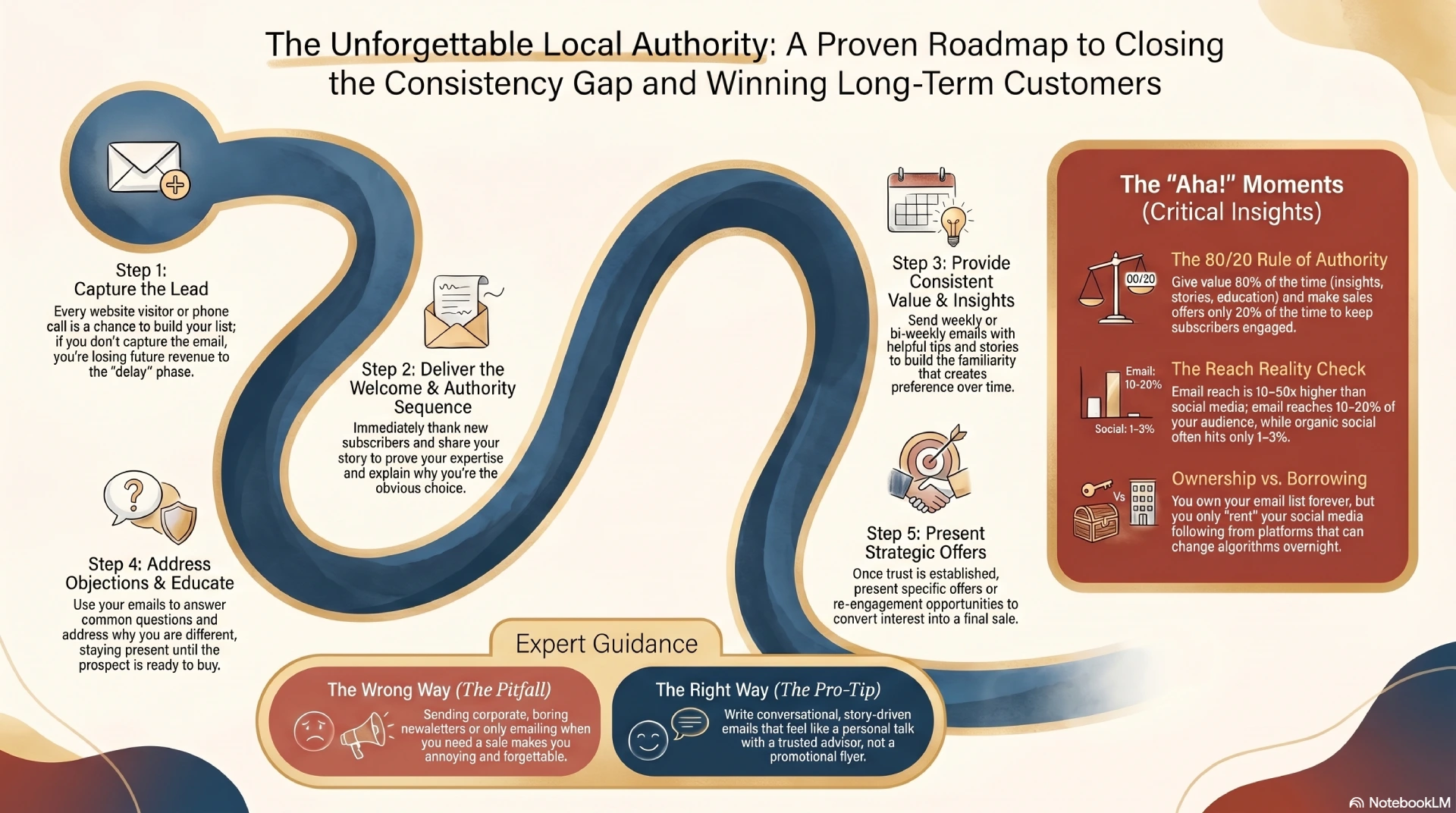
Most buying decisions happen like this:
- Discovery: You find a business (through search, an ad, a referral)
- Interest: You think, “I might need this someday”
- Delay: Life happens. You forget. You get busy.
- Need: Weeks or months later, you actually need the service
- Decision: You choose… whoever you remember or whoever you find in that moment
Here’s the critical insight: Most businesses lose customers in step 3, the delay.
They get discovered. They create interest. Then they disappear from the customer’s awareness entirely.
When the customer finally needs the service, they don’t remember the business they found weeks ago. They search again, find someone new, and the original business never even knows they lost the opportunity.
This is the consistency gap, and email is the most powerful tool for closing it.
Why Email Outperforms Social Media
“But I’m already posting on social media. Isn’t that enough to stay visible?”
Not even close. Here’s why:
1. You Own Your Email List. You Don’t Own Your Social Following.
Social media platforms control who sees your content. Algorithm changes can cut your reach overnight. Your account can be suspended or deleted.
Your email list? That’s yours. Forever. No algorithm decides who sees your message.
2. Email Reach Is 10-50X Higher Than Social Media
The average email open rate is 10-20%. The average organic social media post on a facebook business page reaches 1-3% of your followers if you are lucky.
Translation: Email gets your message in front of 10 times more people than social media.
3. Email Drives Action. Social Media Drives Distraction.
When someone opens your email, they’re focused on your message. When someone scrolls social media, they’re distracted by a hundred other things.
Email is a direct line to your customer’s attention. Social media is competing for scraps of attention in an endless feed.
4. Email Builds Relationships. Social Media Builds Audiences.
Social media is public performance. Email is personal conversation.
When you email someone consistently with value, you’re building a relationship. When you post on social media, you’re broadcasting to an audience that may or may not be paying attention.
The bottom line: Social media has its place. But if you’re relying on it to stay top of mind with potential customers, you’re leaving 90% of your opportunities on the table.
The Three Email Marketing Myths Keeping Local Businesses Invisible
Most business owners avoid email marketing because of three false beliefs:
Myth #1: “Nobody reads emails anymore.”
Reality: People read emails they care about. The problem isn’t that email doesn’t work, it’s that most businesses send boring, salesy, irrelevant emails.
When you send emails that provide value, build relationships, and respect your audience’s time, they get opened, read, and acted upon.
Myth #2: “Email marketing is annoying and pushy.”
Reality: Bad email marketing is annoying. Strategic email nurture is welcomed.
There’s a massive difference between:
- Blasting promotional offers every day (annoying)
- Sending helpful insights, news, tailored offers and value consistently (welcomed)
The businesses that do email right aren’t pushy; they’re helpful, memorable, and trusted.
Myth #3: “I don’t have time to write emails.”
Reality: You don’t have time NOT to stay top of mind with potential customers.
Every week you don’t email your list is a week competitors are winning customers who discovered you first but forgot about you.
The time investment is minimal. The cost of invisibility is massive.
What Makes Email Marketing Work
Email marketing has evolved. What worked 10 years ago doesn’t work today.
Here’s what makes modern email marketing effective:
1. Value-First, Not Sales-First
The emails that get opened and read aren’t pushing offers constantly. They’re providing value:
- Helpful insights
- Stories that build connection
- Education that positions you as the trusted authority
- Relevant offers
The rule: Give value 80% of the time. Make offers 20% of the time.
2. Relationship Building, Not Broadcasting
Effective emails feel like a conversation with a trusted advisor, not a promotional flyer.
They’re:
- Personal (written like you’re talking to one person)
- Conversational (not corporate or stiff)
- Consistent (showing up regularly, not randomly)
- Authentic (real voice, real stories, real value)
3. Strategic Sequences, Not Random Messages
The most powerful email marketing uses nurture sequences, automated series of emails designed to:
- Welcome new subscribers and build trust immediately
- Educate prospects about what makes you different
- Address common objections and questions
- Stay present until prospects are ready to buy
- Re-engage past customers and generate repeat business
This isn’t about sending random newsletters. It’s about systematically building relationships that turn interest into action.
4. Integration with Your Complete Authority System
Email doesn’t work in isolation. It works best when integrated with:
- Your website (capturing emails from visitors)
- Your reputation engine (sharing social proof and testimonials)
- Your advertising (nurturing leads generated from ads)
- Your retargeting (reinforcing messages across channels)
When email is part of your complete marketing system, each piece supports the next, creating compounding momentum.
The Three Types of Emails Every Local Business Needs
Not all emails serve the same purpose. Here are the three essential types:
Type #1: Welcome & Authority-Building Sequence
Purpose: Turn new subscribers into believers
When someone joins your email list (from your website, an ad, a download), they should immediately receive a series of emails that:
- Thank them and deliver what they signed up for
- Introduce who you are and why you’re different
- Share your story and build connection
- Provide immediate value that proves your expertise
- Position you as the obvious choice in your market
Result: New subscribers quickly understand why you’re the go-to authority—before they even consider alternatives.
Type #2: Consistent Value & Relationship Emails
Purpose: Stay top of mind and build trust over time
These are regular emails (weekly or bi-weekly) that:
- Share helpful insights, tips, and stories
- Reinforce your positioning and expertise
- Keep you present in subscribers’ awareness
- Build the familiarity that creates preference
Result: When subscribers finally need your service, you’re the first name they think of—not because you’re pushy, but because you’ve been consistently valuable.
Type #3: Strategic Offer & Re-Engagement Emails
Purpose: Convert interest into action
These emails:
- Present specific offers when relevant
- Re-engage subscribers who haven’t taken action
- Follow up with past customers for repeat business
- Create urgency around time-sensitive opportunities
Result: You systematically convert subscribers into customers without feeling salesy or desperate.
The Real Power of Email: Being Unforgettable
Remember the three authority pillars that help local businesses win?
- Be the Obvious Choice (credibility)
- Be Found First (visibility)
- Be Unforgettable (consistency)
Email is the backbone of pillar #3.
Your website makes you credible. Your search positioning makes you visible. But email makes you unforgettable.
Here’s why this matters:
Most buying decisions don’t happen immediately. Customers need time. They need to think. They need to compare. They need to wait for the right moment.
During that waiting period, which can be days, weeks, or months, one of two things happens:
Option 1: You disappear from their awareness. They forget about you. When they’re finally ready to buy, they search again, find a competitor, and you never even know you lost the opportunity.
Option 2: You stay present through strategic email nurture. You provide value. You build trust. You reinforce your positioning. When they’re ready to buy, you’re the first and only name they consider.
The businesses that master email don’t just win customers, they win customers who were always going to buy eventually, but forgot about everyone except them.
The Wrong Way vs. The Right Way to Use Email
Let’s be clear about what effective email marketing is NOT:
The Wrong Way (Why Most Email Marketing Fails):
- Buying email lists and spamming strangers
- Sending promotional offers constantly
- Writing corporate, boring, generic newsletters
- Emailing randomly with no strategy or sequence
- Ignoring your list for months, then suddenly asking for a sale
- Making every email about you and your business
The Right Way (Real Connection Email That Works):
- Building your list organically from people who want to hear from you
- Providing consistent value and education
- Writing conversational, personal, story-driven emails
- Using strategic sequences that build relationships systematically
- Showing up regularly and reliably
- Making emails about your audience, their problems, desires, and needs
The difference isn’t subtle. One approach makes you forgettable and annoying. The other makes you trusted and inevitable.
Email Marketing Mistakes That Cost Local Businesses Thousands
Here are the most expensive email mistakes I see local businesses make:
Mistake #1: Not Building an Email List at All
Every website visitor, phone call, or customer interaction is an opportunity to capture an email. If you’re not systematically building your list, you’re losing future revenue every single day.
Mistake #2: Building a List But Never Emailing It
Having 500 email subscribers you never email is worse than having none. You’ve built an asset and left it sitting unused while competitors stay top of mind.
Mistake #3: Only Emailing When You Need Something
If the only time you email is when you’re running a promotion or need business, you train your audience to ignore or unsubscribe. Consistency and value must come first.
Mistake #4: Writing Emails That Sound Like Corporate Announcements
Stiff, formal, corporate-sounding emails get deleted. Conversational, personal, story-driven emails get read and remembered.
Mistake #5: Not Integrating Email with Your Marketing System
Email works exponentially better when it’s part of your complete authority system—connected to your website, ads, reputation management, and retargeting.
What This Means for Your Business
If you’re a local business owner who’s good at what you do but struggling with consistent customer activity, email might be the missing piece.
Not because email is magic. But because email solves the consistency gap that causes most businesses to stay invisible.
You can have the best website in your market. You can run the most effective ads. You can have perfect search positioning.
But if you’re not staying top of mind between discovery and decision, you’re losing 90% of the customers who were interested but “not ready yet.”
Email is how you stay unforgettable.
It’s how you turn one-time website visitors into long-term relationships. It’s how you build trust systematically over weeks and months. It’s how you ensure that when customers are finally ready to buy, you’re the only name they’re considering.
The businesses that win in local markets aren’t necessarily the most talented. They’re the ones that show up stronger, build trust faster, and stay present longer.
And email, done right. is the most powerful tool for staying present.
Getting Started: The Email Foundation Your Business Needs
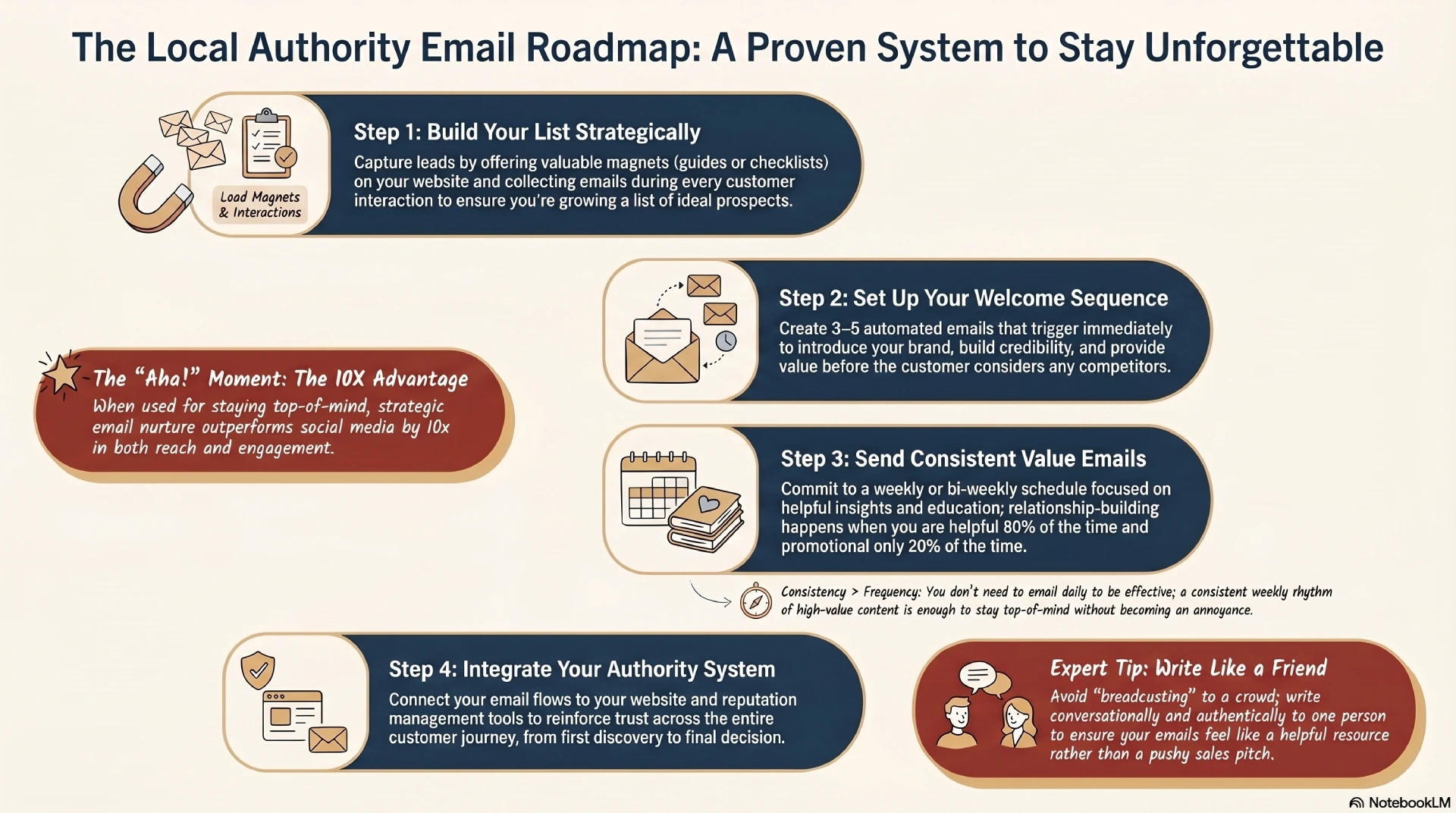
If you’re ready to stop losing customers to the consistency gap, here’s where to start:
Step 1: Build Your List Strategically
- Add email capture to your website (offer something valuable in exchange)
- Collect emails from every customer interaction
- Create lead magnets that attract your ideal customers
- Make joining your list easy and valuable
Step 2: Set Up Your Welcome Sequence
- Create 3-5 automated emails that new subscribers receive immediately
- Introduce yourself, build credibility, and provide immediate value
- Position yourself as the obvious choice before they consider alternatives
Step 3: Send Consistent Value Emails
- Commit to a regular schedule (weekly or bi-weekly)
- Share helpful insights, stories, and education
- Focus on being valuable, not promotional
- Build relationships that compound over time
Step 4: Integrate Email with Your Authority System
- Connect email to your website, advertising, and reputation management
- Use email to reinforce the trust built through other channels
- Create sequences for different customer journey stages
The key: Start simple, stay consistent, and focus on value first.
Next Steps: Building Your Unforgettable System
Email marketing isn’t a standalone tactic. It’s one essential piece of becoming the go-to authority in your local market.
When you combine email with:
- An authority website that builds credibility
- Search positioning that captures high-intent customers
- Reputation management that showcases social proof
- Retargeting that reinforces your presence
…you create a complete system where each piece supports the next, and customers don’t just find you, they choose you with confidence and remember you when it matters most.
Or book a free 45-minute Playbook Consultation where we’ll analyze your current marketing system, identify where you’re losing customers to the consistency gap, and show you exactly how to build the email foundation that keeps you top of mind.
Because being good at what you do gets customers in the door. But staying unforgettable through strategic email nurture is what turns one-time buyers into long-term relationships and consistent revenue.
The best local businesses shouldn’t be the best-kept secrets.
And email marketing, done right, is how you ensure that once customers discover you, they never forget you.
Frequently Asked Questions (FAQ)
How often should I email my list without annoying people?
Consistency matters more than frequency. Weekly emails work well for most local businesses, frequent enough to stay top of mind, but not so often that you become annoying. The key is providing value or relevant content. If every email helps your audience, they’ll welcome your messages. If you’re only promoting, even monthly feels like too much. Start with weekly value-focused emails and adjust based on engagement.
What should I write about in my emails if I’m not always running promotions?
Focus on being helpful, not promotional. Share insights related to your industry, tell stories that build connections, answer common questions your customers ask, provide tips that demonstrate your expertise, and occasionally share customer success stories. The rule: give value 80% of the time, make offers 20% of the time. When you’re consistently valuable, your audience will actually look forward to your emails.
How do I build an email list if I’m just starting?
Start by adding email capture to your website, offer something valuable in exchange (a guide, checklist, consultation, or insider tips). Collect emails from every customer interaction. Create simple lead magnets that solve a specific problem your ideal customers have. Promote your email signup through your social media and advertising. The key is making it easy and valuable for people to join.
Isn’t email marketing expensive or complicated to set up?
No. Modern email marketing platforms are affordable ($10-50/month for most local businesses) and relatively easy to use. The biggest investment is time, writing emails and setting up sequences. But compared to the cost of losing customers who forget about you, the ROI is massive. Start simple with a welcome sequence and weekly emails.
What’s the difference between a newsletter and email nurture?
A newsletter is typically a regular update about your business; events, news, promotions. Email nurture is a strategic system designed to build relationships and guide prospects toward becoming customers. Nurture emails are more personal, story-driven, and value-focused. They’re about the customer’s journey, not just your business updates. Most local businesses benefit more from nurture than newsletters.
How do I write emails that don’t sound salesy or pushy?
Write like you’re talking to a friend, not broadcasting to a crowd. Be conversational, personal, and authentic. Focus on helping, not selling. Share stories, insights, and value first—offers second. Respect your audience’s time and intelligence. When you approach email as relationship-building rather than promotion, it never feels pushy.
Can email marketing really compete with social media and advertising?
Email doesn’t compete with social media and advertising, it complements them. Social media builds awareness. Advertising captures attention. Email builds relationships and maintains presence. The most successful local businesses use all three strategically. But if you had to choose one for staying top of mind, email outperforms social media by 10X in reach and engagement.
How long until I see results from email marketing?
Email is a long-term relationship-building tool, not a quick fix. You might see immediate results from a well-crafted offer to an engaged list, but the real power comes from consistent nurture over weeks and months. Many businesses see measurable results (increased inquiries, bookings, repeat customers) within 60-90 days of consistent, value-focused emailing. The key is starting now and staying consistent.
What if people unsubscribe from my emails?
Unsubscribes are normal and healthy. If someone doesn’t want to hear from you, it’s better they leave than stay and never engage. A smaller, engaged list is far more valuable than a large, uninterested one. Expect 1-2% unsubscribe rates. If it’s higher, evaluate whether you’re providing enough value and not being too promotional. Focus on serving the people who want to hear from you.
How does email fit into the Go-To Local Authority Roadmap?
Email is a core component of the “Be Unforgettable” pillar. While your website builds credibility (Be the Obvious Choice) and search positioning creates visibility (Be Found First), email maintains presence and builds relationships over time (Be Unforgettable). It works with retargeting and direct mail to ensure you stay top of mind from first discovery to final buying decision. It’s the system that turns interest into action.
At Clay Jar Marketing we’re not just another agency pushing random tactics. We are your marketing partner. We work alongside you to help you scale and grow your business while freeing up your time so that you can focus on what really matters. We’ve walked this path, we understand the struggle, and we’re here to help you succeed. Every potential partnership starts with our comprehensive Playbook consultation, a deep-dive analysis that shows you exactly what to build, in what order, to capture customers at every stage of their journey. Ready to get started?

Sam McKeen