Why Most Nonprofits Are Invisible to the People Who Want to Support Them (And How AI Search Makes It Worse)
Summary
Nonprofit organizations face a unique marketing paradox: the people who care most about your mission are actively searching for ways to help, but most nonprofits remain invisible to them. Traditional nonprofit marketing advice; focused on galas, direct mail, and social media posting etc. fails to address the fundamental problem: discoverability.
The rise of AI-powered search tools like ChatGPT, Gemini, and Perplexity has made this problem exponentially worse. When potential donors ask AI “What’s the best charity fighting food insecurity in my city?” or “Where should I volunteer to help homeless youth?” AI makes specific recommendations based on structured, credible information it can find and verify.
If your nonprofit’s digital presence isn’t optimized for AI discoverability, you’re invisible to these searches, even if you’re doing transformational work in your community.
This comprehensive guide reveals why most nonprofit marketing fails, how AI search has changed the rules of discoverability, and the systematic approach mission-driven organizations need to ensure supporters can find you when they’re ready to give, volunteer, or advocate.
Introduction: Your Mission Deserves to Be Found
You didn’t start your nonprofit for recognition, you started it because you saw a problem that needed solving and people who needed help.
You’ve poured your heart into building programs that work. You’ve stretched limited resources to serve more people. You’ve celebrated small victories and persevered through setbacks. You know the transformational impact your organization creates.
But here’s the heartbreaking reality: the people who would champion your cause, donate to your mission, and volunteer their time don’t know you exist.
Right now, in your community, there are:
- Donors searching for trustworthy organizations addressing the exact issue you tackle
- Volunteers looking for meaningful ways to contribute their skills to causes like yours
- Corporations seeking nonprofit partners for their community investment programs
- Foundations evaluating which organizations to fund
- Individuals experiencing the exact problem your programs solve
They’re searching. You’re serving. But you’re not connecting.
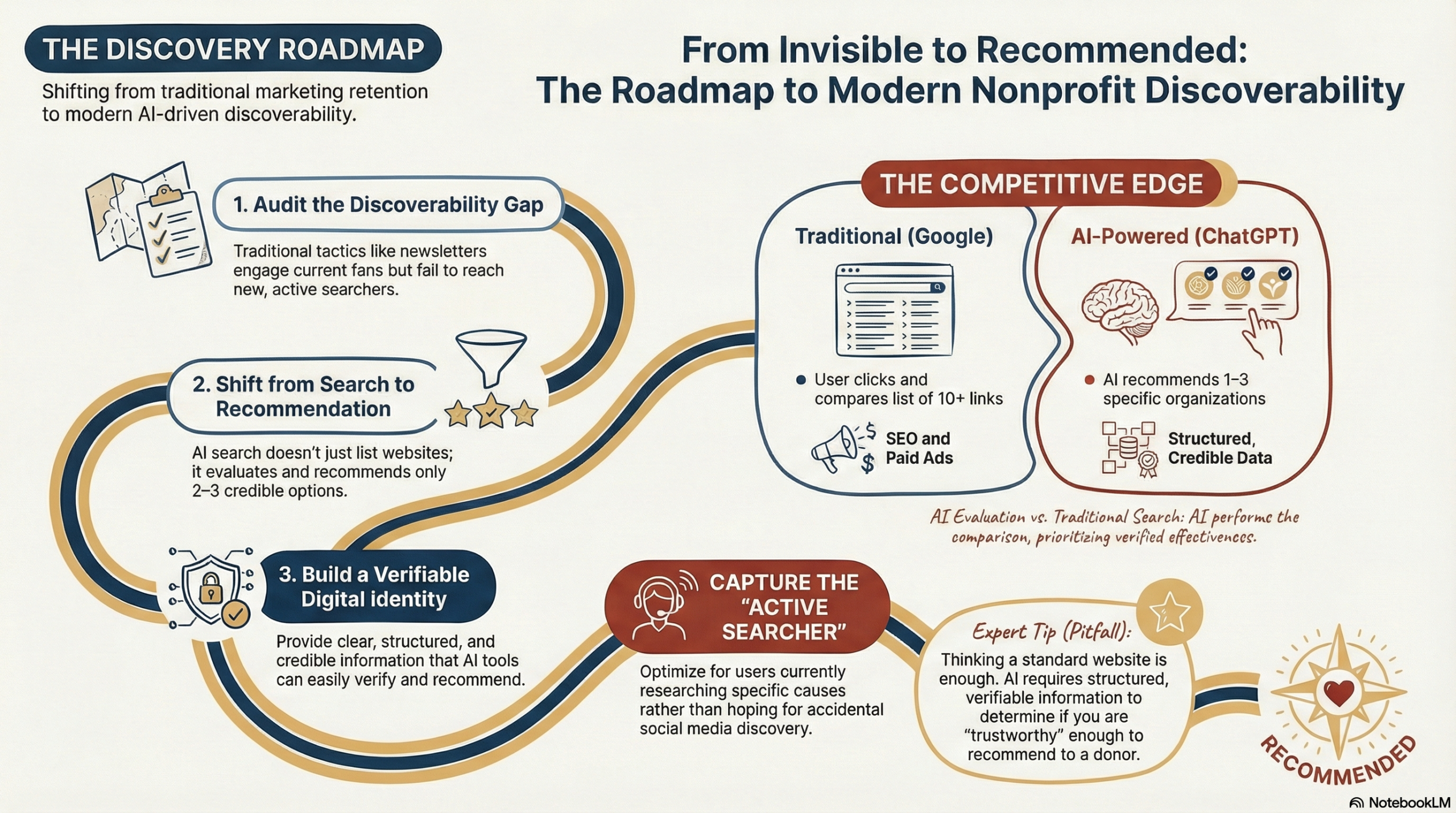
And the rise of AI-powered search has made this disconnect even more critical. When someone asks ChatGPT or Perplexity “What nonprofit should I support to help homeless families in Manchester, NH?” AI doesn’t return a list of 20 options, it analyzes available information and recommends 2-3 organizations it determines are credible, effective, and trustworthy.
If your nonprofit isn’t one of those recommendations, you’ve lost a supporter who was actively looking for you.
This isn’t about becoming a marketing-focused organization. It’s about ensuring that the life-changing work you’re already doing gets the visibility, support, and resources it deserves.
The Nonprofit Marketing Problem: Why Traditional Advice Fails
The Conventional Nonprofit Marketing Playbook
If you’ve sought marketing advice for your nonprofit, you’ve probably heard some version of this:
“You need to:
- Post consistently on social media (Facebook, Instagram, TikTok)
- Send regular email newsletters
- Host fundraising events and galas
- Build relationships with major donors
- Tell compelling stories
- Create emotional appeals
- Apply for grants
- Build a volunteer base through word-of-mouth”
Here’s the problem: none of this addresses discoverability.
These tactics assume people already know about your organization. They’re designed to engage existing supporters, not help new ones find you in the first place.
The Three Critical Questions Traditional Marketing Doesn’t Answer
Question 1: How do people who care about your cause but don’t know about your organization find you?
Traditional marketing answer: “They’ll hear about you through word-of-mouth, see your social posts, or attend your events.”
Reality: Most people who would support your mission never encounter your social posts, don’t attend community events, and aren’t connected to your existing network.
Question 2: When someone searches for nonprofits addressing your cause, does your organization appear?
Traditional marketing answer: “We have a website, so we should show up in search results.”
Reality: Having a website isn’t enough. AI-powered search prioritizes organizations with clear, structured, credible information, and most nonprofit websites don’t provide this.
Question 3: How do you capture people actively looking for ways to help right now?
Traditional marketing answer: “Build awareness through social media and hope they remember you when they’re ready to give.”
Reality: By the time someone is ready to donate or volunteer, they’re doing active research. If you’re not discoverable at that moment, they’ll find and support someone else.
Why the Traditional Playbook Fails
It’s Built for Retention, Not Acquisition
Most nonprofit marketing advice focuses on keeping existing supporters engaged (newsletters, events, storytelling) rather than helping new supporters discover you.
It Assumes Visibility You Don’t Have
Social media strategies assume your posts will reach people who care about your cause. But algorithms show your content primarily to people who already follow you—which doesn’t solve the discoverability problem.
It Ignores How Modern Supporters Actually Search
People don’t browse Facebook hoping to stumble upon a worthy cause. They actively search: “best nonprofit fighting hunger in Boston,” “where to volunteer with homeless youth,” “most effective environmental organizations.”
If you’re not optimized for these searches, you’re invisible.
It Doesn’t Account for AI-Powered Recommendations
AI tools are increasingly how people discover organizations. When AI can’t find clear, structured information about your nonprofit, it recommends competitors instead.
How AI Search Has Changed Nonprofit Discoverability Forever
Traditional Search vs. AI-Powered Search
Traditional Search (Google):
- Returns list of websites
- User clicks through multiple options
- User evaluates and compares themselves
- Visibility depends on SEO and paid ads
AI-Powered Search (ChatGPT, Gemini, Perplexity):
- Provides direct answers with specific recommendations
- Often names 1-3 organizations, not 10+
- AI does the evaluation and comparison
- Visibility depends on structured, credible information AI can verify
The Critical Difference:
Traditional search gives people options to evaluate. AI search makes the evaluation for them and recommends specific organizations.
If AI can’t understand what you do, who you serve, and why you’re credible, you won’t be recommended, even if you’re the most effective organization in your space.
How AI Evaluates Nonprofits
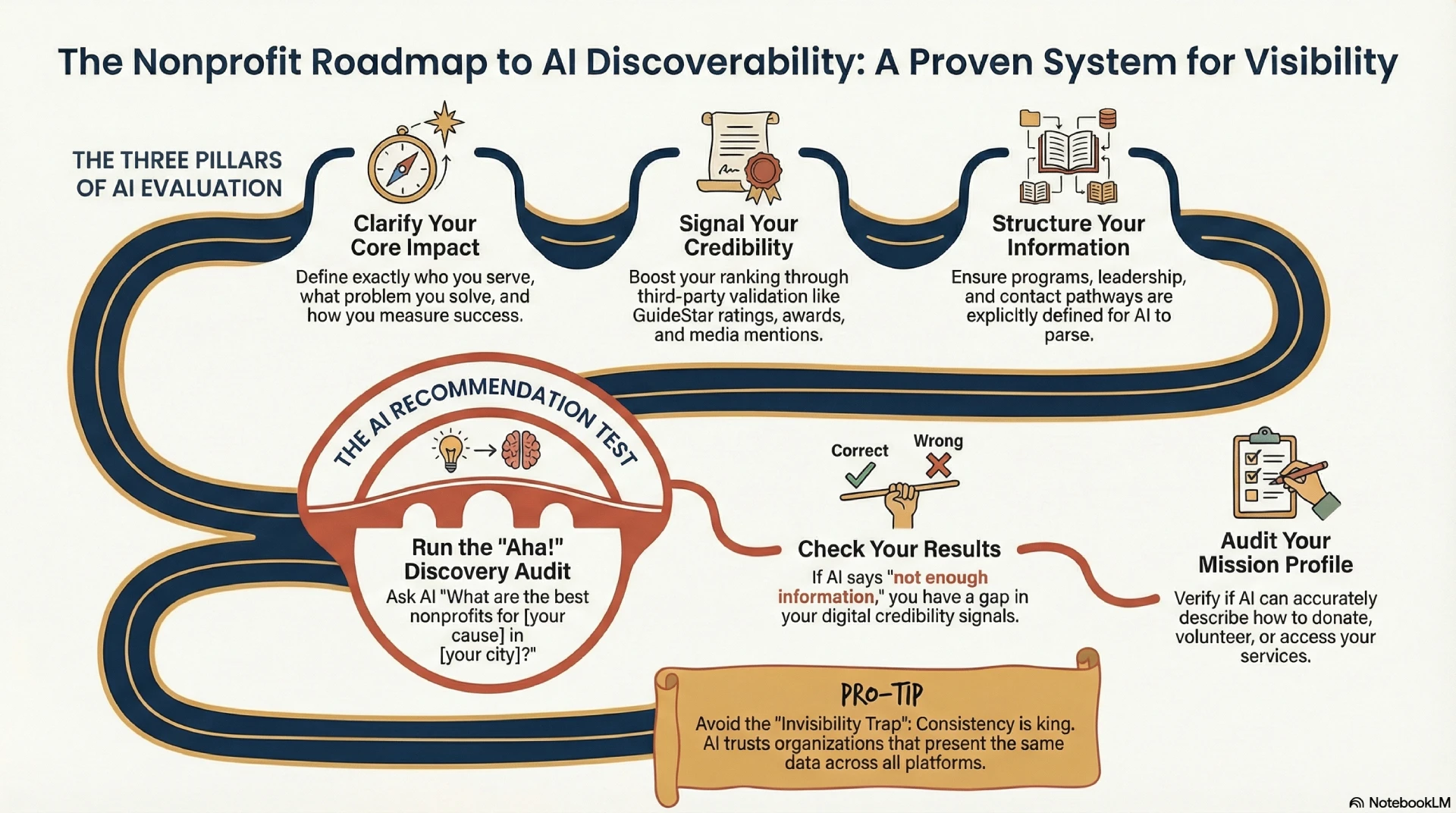
AI doesn’t just read your mission statement, it builds a comprehensive understanding of your organization by analyzing:
Clarity of Mission and Impact:
- What problem do you solve?
- Who do you serve?
- What outcomes do you achieve?
- How do you measure success?
Credibility Signals:
- Third-party validation (grants, awards, media mentions)
- Financial transparency (GuideStar, Charity Navigator ratings)
- Consistent information across platforms
- Evidence of active operations (recent news, events, impact reports)
Structured Information:
- Programs clearly described
- Service areas explicitly stated
- Leadership and governance information
- Contact and engagement pathways clearly defined
Community Recognition:
- Media coverage and mentions
- Partner organizations and collaborations
- Donor testimonials and volunteer reviews
- Community impact stories from third parties
Real-World Example: The AI Recommendation Test
Try this experiment right now:
Ask ChatGPT or Perplexity: “What are the best nonprofits addressing [your cause] in [your city]?”
What you’ll likely discover:
- AI recommends 2-4 specific organizations
- Those organizations have clear, structured information AI could parse
- They have third-party credibility signals (media mentions, ratings, partnerships)
- They explicitly state what they do, who they serve, and how to get involved
Now search for your own organization: “Tell me about [Your Nonprofit Name]”
What AI knows about you reveals your discoverability:
- Can AI accurately describe your mission and programs?
- Does it understand who you serve and what impact you create?
- Can it tell people how to donate, volunteer, or access services?
- Does it cite credible sources, or does it say “I don’t have enough information”?
This is what potential supporters see when they search for organizations like yours.

The Customer Activity Roadmap for Nonprofits: A Systematic Approach to Discoverability
At Clay Jar, we apply the Customer Activity Roadmap framework to nonprofit marketing building discoverability systematically rather than through random tactics.
The Three Tiers of Nonprofit Discoverability
Foundation Tier: Be Found and Trusted
Before you can engage supporters, they need to find you and trust you.
Foundation elements include:
- Clear, consistent organizational identity across all platforms
- Credible online presence (website, GuideStar profile, social profiles)
- Transparent financial and impact information
- Third-party validation (ratings, media coverage, partnerships)
- AI-friendly structured information about mission, programs, and impact
Without a strong foundation, all other marketing efforts work harder for less return.
Active Searchers Tier: Capture People Looking for You Now
Active searchers are people actively looking for ways to help with your cause right now.
They’re searching:
- “Best charity for homeless families in [city]”
- “Where to volunteer with youth programs”
- “Nonprofits fighting food insecurity near me”
- “How to donate to environmental causes”
Strategies to capture active searchers:
- Search engine optimization for cause-related keywords
- Google Grants (free advertising for nonprofits)
- AI discoverability optimization
- Clear pathways on your website for different supporter types (donors, volunteers, beneficiaries)
- Local search optimization (Google Business Profile)
Passive Searchers Tier: Build Awareness with Future Supporters
Passive searchers aren’t actively looking for your organization yet, but they care about your cause and could become supporters in the future.
Strategies to reach passive searchers:
- Content marketing that addresses questions your audience asks
- Social media presence that builds community
- Partnerships and collaborations that expand reach
- Events and campaigns that create awareness
- Storytelling that emotionally connects people to your mission
The Critical Insight: You Must Build in Order
Most nonprofits skip Foundation and jump straight to Passive Searchers (social media, events, storytelling). This is backwards.
Without Foundation:
- People who hear about you can’t verify your credibility
- Active searchers looking for organizations like yours can’t find you
- AI systems don’t recommend you
- Your awareness efforts convert poorly because there’s no trust infrastructure
The Right Sequence:
- Build Foundation (so people can find and trust you)
- Capture Active Searchers (connect with people looking for you now)
- Expand to Passive Searchers (build awareness with future supporters)
Strategy 1: Build Your Foundation – Become a Clear, Credible Entity
The Nonprofit Entity Recognition Challenge
AI builds an “entity profile” for your organization—a comprehensive understanding of who you are, what you do, and whether you’re trustworthy.
When your information is inconsistent, incomplete, or unclear, AI can’t build confidence in recommending you.
What to Do: Create Entity Clarity
Use Consistent Organization Name Everywhere
Choose one official name and use it identically across:
- Website
- GuideStar/Candid profile
- Social media profiles
- Grant applications
- Media mentions
- IRS records
- Partnership materials
Don’t switch between:
- “Hope Community Center”
- “Hope Center”
- “HCC”
- “The Hope Community Center”
Develop One Clear Mission Statement
Your mission statement should communicate:
- What problem you solve: The specific issue you address
- Who you serve: Your target beneficiary population
- How you help: Your approach or method
- Where you operate: Geographic service area
Example Mission Statements:
❌ Vague: “Empowering communities to thrive through compassionate service and transformational programs…”
✅ Clear: “Providing emergency shelter, transitional housing, and job training to homeless families in Metro Atlanta.”
❌ Vague: “Building a brighter future for children through education and support…”
✅ Clear: “Offering after-school tutoring, mentorship, and college prep programs to underserved students in grades 6-12 in South Chicago.”
Essential Foundation Elements
- Professional, Informative Website
Your website is the primary source AI uses to understand your organization.
Must-have pages:
- About/Mission: Clear explanation of what you do and why
- Programs/Services: Specific description of each program
- Impact: Measurable outcomes and success stories
- Get Involved: Clear pathways for donors, volunteers, and beneficiaries
- Leadership/Team: Information about staff and board
- Contact: Multiple ways to reach you
- FAQ: Answers to common questions about your work
- Complete GuideStar/Candid Profile
GuideStar (now part of Candid) is one of the primary sources AI uses to verify nonprofit credibility.
Claim and complete your profile with:
- Mission statement
- Program descriptions
- Financial information
- Leadership details
- Impact metrics
- Photos and videos
- Financial Transparency
Supporters want to know their donations will be used effectively.
Publish on your website:
- Annual reports
- IRS Form 990
- Financial statements
- Program expense breakdown
- Impact per dollar metrics
- Third-Party Credibility Signals
AI trusts information from independent sources more than self-promotion.
Build credibility through:
- Charity Navigator or GuideStar ratings
- Media coverage and press mentions
- Awards and recognition
- Partnerships with established organizations
- Grants from recognized foundations
- Endorsements from community leaders
Strategy 2: Optimize for AI Discoverability
Make Your Organization AI-Readable
AI systems need structured, explicit information to understand and recommend your nonprofit.
AI-Friendly Organizational Information
Create a “What We Do” Section
Don’t make AI guess what programs you offer. State them explicitly:
Example Structure:
Our Programs:
Emergency Shelter Program
- Who it serves: Homeless families with children
- What it provides: Safe overnight shelter, meals, case management
- Capacity: 50 families per night
- How to access: Walk-in or referral from partner agencies
Transitional Housing Program
- Who it serves: Families transitioning from homelessness to permanent housing
- What it provides: Subsidized housing for up to 18 months, job training, financial literacy
- Capacity: 25 families
- How to access: Application through emergency shelter program
Job Training & Placement
- Who it serves: Adults experiencing homelessness or housing instability
- What it provides: Skills training, resume help, interview prep, employer connections
- Outcomes: 78% job placement rate within 6 months
- How to access: Enrollment through shelter or housing programs
AI-Optimized Mission and Impact Statements
Use the “Who, What, Where, Why” Framework:
Who We Serve: “We serve homeless families with children in Metro Atlanta, with a focus on single mothers fleeing domestic violence.”
What We Provide: “We provide emergency shelter, transitional housing, job training, childcare support, and case management services.”
Where We Operate: “We operate three shelter facilities and 40 transitional housing units across Fulton and DeKalb counties.”
Why We’re Effective: “Since 2010, we’ve helped over 2,500 families transition from homelessness to stable housing, with an 82% success rate of families remaining housed after two years.”
Create an FAQ Section for AI
Add a dedicated FAQ page that answers questions AI systems (and potential supporters) commonly ask:
Sample Nonprofit FAQ:
Q: What does [Organization Name] do? A: [Organization Name] provides emergency shelter, transitional housing, and job training to homeless families in [location]. We serve approximately 200 families annually.
Q: How can I donate to [Organization Name]? A: You can donate online at [URL], by mail to [address], or by calling [phone]. We accept one-time and recurring donations, and we’re a 501(c)(3) tax-exempt organization.
Q: How can I volunteer with [Organization Name]? A: We need volunteers for meal service, tutoring, childcare, job coaching, and administrative support. Visit [volunteer page URL] or email [volunteer coordinator email] to get started.
Q: Who is eligible for services at [Organization Name]? A: We serve families with children experiencing homelessness in Metro Atlanta. Families can access emergency shelter through walk-in or agency referral. No one is turned away due to inability to pay.
Q: How effective is [Organization Name]? A: 82% of families who complete our transitional housing program remain stably housed two years later. Our job training program has a 78% placement rate within six months.
Q: How is [Organization Name] funded? A: We’re funded through individual donations (45%), foundation grants (30%), government contracts (15%), and corporate partnerships (10%). View our complete financial information at [URL].
Strategy 3: Capture Active Searchers – Be Found When People Are Looking
Active searchers are the highest-value opportunity for nonprofits: people actively looking for organizations like yours right now.
Understanding Active Searcher Intent
Active searchers are asking:
- “Where can I volunteer in [city] to help [cause]?”
- “Best charity to donate to for [cause]?”
- “Nonprofits helping [specific population] near me”
- “How to get help with [problem your organization solves]”
- “Organizations fighting [issue] in [location]”
These searches represent:
- Donors ready to give
- Volunteers ready to serve
- Beneficiaries needing help
- Partners looking for collaboration
- Journalists seeking expert sources
If you’re not discoverable for these searches, you’re losing support daily.
Optimize for Cause + Location Searches
Identify Your Core Search Terms:
What would someone type or ask AI if they were looking for an organization exactly like yours?
Examples:
- “Homeless family shelter Atlanta”
- “Youth mentoring programs Chicago”
- “Food bank volunteer opportunities Denver”
- “Domestic violence services Dallas”
- “Environmental nonprofits Seattle”
Optimize your website for these terms:
Use them in:
- Page titles and headings
- Program descriptions
- Mission statement
- Meta descriptions
- Image alt text
- FAQ answers
Example Optimization:
Instead of: “Our innovative approach transforms lives through comprehensive support…”
Use: “Hope Community Center provides emergency shelter and transitional housing to homeless families in Metro Atlanta, serving over 200 families annually with job training, childcare, and case management.”
Leverage Google Grants
Google offers up to $10,000/month in free advertising for eligible nonprofits through Google Ad Grants.
This allows you to:
- Appear at the top of search results for relevant keywords
- Capture people actively searching for services or ways to help
- Drive traffic to specific programs or donation pages
- Track which searches bring the most engaged supporters
Eligibility requirements:
- Valid 501(c)(3) status
- Functioning website with substantial content
- No discrimination policies
Common mistake: Many nonprofits get approved for Google Grants but don’t use them effectively because they don’t understand search intent or keyword strategy.
Optimize Your Google Business Profile
If you have a physical location where people can visit, volunteer, or access services, claim and optimize your Google Business Profile.
Include:
- Accurate hours of operation
- Clear description of services
- Photos of your facility and programs
- Categories that match how people search
- Posts about events and needs
- Response to reviews
This helps you appear in:
- “Nonprofits near me” searches
- Map results
- Local pack results
- AI location-based recommendations
Strategy 4: Build Passive Awareness That Converts
Once your Foundation is solid and you’re capturing Active Searchers, you can effectively build awareness with people who aren’t actively looking yet.
Content That Answers Questions Your Audience Asks
Create blog posts, videos, or resources that answer questions related to your cause:
For a homeless services organization:
- “What to do if you’re facing eviction in Atlanta”
- “How to help homeless families in your community”
- “Understanding the root causes of family homelessness”
- “What happens when a family enters emergency shelter”
For a youth mentoring program:
- “Signs your teen could benefit from mentoring”
- “How to become a youth mentor”
- “The impact of mentoring on academic success”
- “What happens in a mentoring relationship”
Why this works:
- Positions you as an expert resource
- Provides value before asking for support
- Captures people early in their awareness journey
- Gives AI more content to understand your expertise
- Creates shareable resources that expand reach
Strategic Storytelling on Social Media
Now that you have Foundation and Active Searcher strategies in place, social media becomes more effective.
Share stories that:
- Illustrate your impact with specific examples
- Show the people behind your mission (staff, volunteers, beneficiaries)
- Demonstrate transparency and accountability
- Invite participation and engagement
- Connect emotionally while providing concrete information
Key difference from traditional social media advice:
You’re not trying to build your entire supporter base through social media. You’re using it to:
- Stay top-of-mind with existing supporters
- Provide shareable content that extends reach
- Build community and connection
- Give people who discovered you through search reasons to stay engaged
Partnerships and Collaborations
Partner with organizations that already have the audience you’re trying to reach:
Examples:
- Corporate volunteer programs
- Faith communities
- Civic organizations
- Schools and universities
- Other nonprofits serving adjacent needs
These partnerships:
- Provide third-party credibility
- Expand your reach
- Create opportunities for media coverage
- Generate backlinks that improve search visibility
- Give AI additional sources to verify your wor
Common Nonprofit Marketing Mistakes That Kill Discoverability
Mistake #1: Vague Mission Statements
Problem: “Empowering communities to create lasting change through innovative programs and compassionate service.”
What AI understands: Nothing specific.
Fix: “Providing job training, affordable childcare, and financial literacy programs to single mothers in Detroit transitioning from public assistance to economic independence.”
Mistake #2: Program Descriptions That Don’t Explain Who, What, or How
Problem: “Our transformational youth program builds character and creates opportunities for success.”
What’s missing: Who’s eligible? What does the program actually include? How do youth participate? What outcomes do you achieve?
Fix: “Our after-school program serves 150 students in grades 6-8 from Lincoln Middle School, providing homework help, STEM enrichment, and mentoring four days per week. 95% of participants improve their grades, and 100% advance to the next grade level.”
Mistake #3: No Clear Pathways for Different Audiences
Your website visitors have different needs:
- Beneficiaries need to know: Am I eligible? How do I access services?
- Donors need to know: What impact will my donation create? How do I give?
- Volunteers need to know: What opportunities exist? How do I sign up?
- Partners need to know: How can we collaborate?
Most nonprofit websites make all these audiences hunt for information.
Fix: Create clear, separate pathways for each audience type, accessible from your homepage.
Mistake #4: Hiding Financial Information
Transparency builds trust. Hiding or making it difficult to find financial information creates suspicion.
Fix: Make your Form 990, annual reports, and financial statements easily accessible. Include a simple breakdown of how donations are used.
Mistake #5: Inconsistent Information Across Platforms
Your mission statement on your website doesn’t match your GuideStar profile. Your social media says you serve one population, but your grant applications say another.
This confuses AI and reduces confidence in recommending you.
Fix: Audit all your platforms and ensure core information (mission, programs, service area, impact metrics) is consistent everywhere.
Mistake #6: No Evidence of Current Activity
Your website’s latest news is from 2021. Your social media hasn’t been updated in months. Your impact report is three years old.
AI interprets this as: This organization may no longer be active or effective.
Fix: Regularly update your website, social media, and impact information. Even simple updates signal active operations.
Mistake #7: Jumping to Passive Strategies Before Building Foundation
Running social media campaigns, hosting fundraising events, and creating awareness content without first building Foundation and Active Searcher strategies means:
- People who hear about you can’t verify your credibility
- Awareness doesn’t convert to support
- You’re working much harder for much less return
Fix: Build in order—Foundation first, then Active Searchers, then Passive awareness.
The AI Opportunity: What’s Coming and How to Prepare
AI Is Becoming the Primary Research Tool
More people are using AI to research nonprofits before donating, volunteering, or accessing services.
They’re asking:
- “What’s the most effective charity for [cause]?”
- “Should I donate to [your organization]?”
- “What do reviews say about [your organization]?”
- “How does [your organization] compare to [competitor]?”
AI answers these questions based on the information it can find and verify.
Voice Search and Conversational AI
As voice assistants and conversational AI become more prevalent, searches become more natural:
- “Hey Siri, where should I volunteer to help homeless families?”
- “Alexa, what’s a good charity fighting hunger in my city?”
- “ChatGPT, I want to donate $500 to an environmental nonprofit—who should I support?”
These conversational queries rely heavily on structured information and credibility signals.
AI-Powered Donor Matching
Emerging platforms use AI to match donors with nonprofits based on:
- Cause areas of interest
- Geographic preferences
- Giving history
- Effectiveness metrics
- Mission alignment
Nonprofits with clear, structured, credible information will be matched more frequently.
The Competitive Advantage Window
Right now, most nonprofits don’t understand AI discoverability.
This creates an opportunity: Organizations that optimize for AI now will dominate recommendations for years to come.
The nonprofits that wait will find themselves invisible to an increasingly large percentage of potential supporters.
Action Steps: What to Do Right Now
This Week:
- Test your AI discoverability: Ask ChatGPT or Perplexity about your organization and see what it knows
- Audit your mission statement: Is it clear, specific, and consistent across platforms?
- Check your GuideStar profile: Is it claimed and complete?
- Review your website: Can someone quickly understand what you do, who you serve, and how to get involved?
- Identify your core search terms: What would someone type if looking for an organization like yours?
This Month:
- Create AI-friendly program descriptions using the Who/What/Where/Why framework
- Add an FAQ section to your website answering common questions
- Ensure name consistency across all platforms
- Publish financial transparency information (990, annual report, expense breakdown)
- Apply for Google Ad Grants if eligible
- Optimize your Google Business Profile if you have a physical location
This Quarter:
- Develop content that answers questions your audience asks
- Pursue media coverage or partnership announcements for third-party credibility
- Create clear pathways on your website for donors, volunteers, and beneficiaries
- Update all outdated information (impact reports, news, social media)
- Build or strengthen relationships with partner organizations
- Implement basic SEO for cause + location keywords
This Year:
- Build consistent content rhythm (blog, social media, impact updates)
- Pursue strategic partnerships that expand reach and credibility
- Maintain active, current digital presence across all platforms
- Track and optimize what’s working (which searches bring supporters, which content converts)
- Continuously refine your messaging based on what resonates with supporters
Frequently Asked Questions
Do small nonprofits really need to worry about AI discoverability?
Yes, especially small nonprofits. Larger organizations often have brand recognition and established supporter bases. Smaller nonprofits depend more heavily on being discovered by new supporters. AI levels the playing field if you have clear, credible information, regardless of your size.
We barely have time to run our programs. How can we add marketing to our workload?
This is exactly why the systematic approach matters. Random marketing tactics (posting daily on social media, constant event planning) are time-intensive and low-return. Building Foundation and optimizing for Active Searchers requires upfront effort but then works continuously without constant attention. Focus on the 20% of activities that drive 80% of results.
Isn’t focusing on marketing a distraction from our mission?
Being discoverable isn’t a distraction from your mission—it’s essential to fulfilling it. The families you could help, the donors who want to support you, and the volunteers ready to serve can’t connect with you if they can’t find you. Discoverability is mission-critical.
We get most of our support from a few major donors. Do we still need broader discoverability?
Yes, for sustainability. Dependence on a small donor base is risky. Broader discoverability helps you: build a diversified funding base, find new major donors, attract volunteers and in-kind support, increase impact by reaching more beneficiaries, and build organizational resilience.
How long does it take to see results from these strategies?
Foundation building and AI optimization show results within 3-6 months. You may see some immediate impact (better website conversion, increased inquiries), but building strong discoverability is a medium-term investment that pays long-term dividends.
What if we don’t have impressive metrics or outcomes to share yet?
Share what you have honestly. AI values transparency and specificity over perfection. “We served 50 families last year and 40 reported improved housing stability” is more credible than vague claims about “transforming communities.” As you grow, your metrics will grow—but clarity matters more than scale.
Should we hire a marketing agency or do this ourselves?
Foundation work (clarifying mission, ensuring consistency, optimizing website) you can do internally—it requires deep understanding of your organization. Implementation support (SEO, Google Grants management, content creation) can be delegated to someone who understands nonprofit discoverability. Avoid agencies that push tactics without understanding the systematic approach.
How do we balance storytelling with the structured information AI needs?
You need both. Use structured, clear information for discoverability (mission statements, program descriptions, FAQs). Use storytelling for engagement and emotional connection (social media, newsletters, impact reports). They serve different purposes and both matter.
What if there are negative reviews or criticism of our organization online?
Address it transparently. Respond professionally to criticism, explain what you’re doing to improve, and ensure current, positive information is prominent. AI recognizes organizations that engage with feedback professionally. You can’t erase the internet, but you can ensure accurate, current information is most visible.
We’re faith-based. Does that affect our discoverability strategy?
Be clear about your faith affiliation in your mission and program descriptions. This helps AI match you with supporters specifically looking for faith-based organizations while maintaining discoverability for those searching by cause or service type. Clarity about your identity strengthens rather than limits discoverability.
Conclusion: Your Mission Deserves to Be Found
The rise of AI-powered search hasn’t changed the fundamental truth that effective, mission-driven work matters—it’s amplified the importance of ensuring people can discover that work.
For nonprofit leaders who’ve poured their hearts into building programs that genuinely help people, this is actually good news. You already have the hardest part—the meaningful impact. Now you need to ensure the people who want to support your mission can actually find you.
This isn’t about becoming a marketing-focused organization. It’s about building the systematic discoverability infrastructure that allows your mission to reach its full potential.
Nonprofits that are clear about their mission, consistent in their messaging, and credible through third-party validation will be discovered and supported. Nonprofits that remain vague, inconsistent, or invisible to AI will struggle, no matter how transformational their work is.
The donors who want to support your cause are searching. The volunteers who want to serve are looking. The people who need your help are seeking solutions.
The question is: Will they find you?
The answer depends on what you do next.
Ready to Build Your Nonprofit’s Discoverability Foundation?
At Clay Jar Marketing, we understand that nonprofit marketing isn’t about flashy campaigns or expensive ads, it’s about ensuring the people who care about your mission can find you when they’re ready to support, serve, or be served.
We specialize in helping mission-driven organizations build systematic discoverability using the Customer Activity Roadmap framework.
What’s Included in Our Nonprofit Discoverability Consultation:
- Comprehensive audit of your current digital presence and AI discoverability
- Mission clarity assessment to ensure your message resonates with AI and supporters
- Foundation analysis identifying gaps in credibility and consistency
- Active searcher strategy to capture people looking for organizations like yours now
- Customized roadmap showing exactly what to optimize and in what order
- Implementation guidance so you can build discoverability systematically
Schedule Your Free Discoverability Consultation
Because your mission is too important to remain invisible to the people who want to help.
Get Started Today
At Clay Jar Marketing we’re not just another agency pushing random tactics. We are your marketing partner. We work alongside you to help you scale and grow your business while freeing up your time so that you can focus on what really matters. We’ve walked this path, we understand the struggle, and we’re here to help you succeed. Every potential partnership starts with our comprehensive Playbook consultation, a deep-dive analysis that shows you exactly what to build, in what order, to capture customers at every stage of their journey. Ready to get started?

Sam McKeen