Reading time: 11 minutes
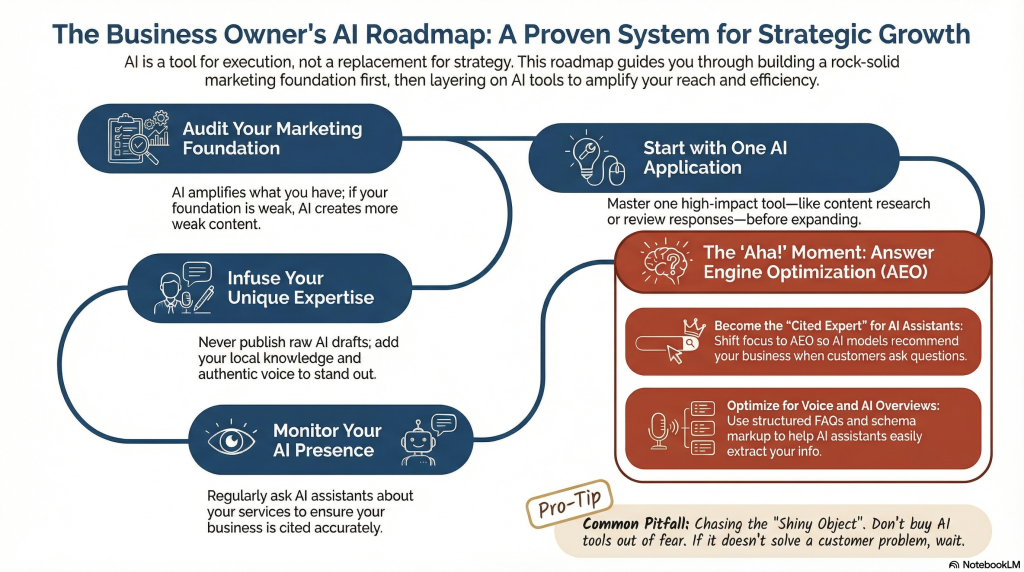
Key Takeaways: You’re not behind. Most businesses haven’t implemented AI yet. The key is building your marketing foundation FIRST: website, Google Business Profile, directory listings, and basic SEO then strategically adding AI tools.
The most important AI change for businesses: Answer Engine Optimization (AEO), optimizing your content so AI assistants and platforms will cite you as the expert when customers ask questions about your services.
Where to start:
- Audit your foundation first
- Start with one AI application
- Add your expertise to all AI-generated content
- Monitor how AI assistants represent your business
“AI is a tool for execution, not a replacement for strategy. Use it to amplify what works, not to build on a weak foundation.”
You’ve seen the headlines. AI is transforming everything. Businesses using AI are leaving competitors in the dust. If you’re not adapting now, you’ll be obsolete.
And if you’re a business owner, you’re probably feeling something between mild anxiety and full-blown panic.
You know AI is important. You know you should be doing something with it. But you’re overwhelmed by the options, confused by the technical jargon, and honestly not sure where to even start.
Should you be using ChatGPT to write your content? Do you need AI chatbots on your website? Is your business already falling behind because you haven’t implemented AI yet? And how are you supposed to figure all this out when you’re already stretched thin just running your business?
Here’s what I want you to know: Your fear is valid, but it’s also being amplified by people selling AI tools and services.
The truth is more nuanced, and more hopeful, than the panic-inducing headlines suggest.
Yes, AI is changing how customers find businesses and how marketing works. But no, you’re not hopelessly behind. And no, you don’t need to implement every AI tool tomorrow to survive.
What you need is clarity on what AI actually means for your business, where it fits in your marketing strategy, and what specific steps to take first, without the overwhelm.
Let me show you exactly that.
The AI Panic That’s Paralyzing Local Business Owners
Let’s start by naming what you’re probably feeling right now.
The fear sounds like this:
- “Everyone’s talking about AI, but I don’t even know where to start.”
- “My competitors are probably already using AI and getting ahead while I’m stuck.”
- “I’m going to invest in the wrong AI tools and waste money I can’t afford to lose.”
- “Technology moves so fast, by the time I learn one thing, it’ll already be outdated.”
- “I built my business on personal relationships and quality work. Will AI make that irrelevant?”
- “I don’t have time to learn all this new technology, I’m barely keeping up as it is.”
And here’s what makes it worse:
Every day, you’re bombarded with messages telling you that AI is essential, revolutionary, and urgent. Marketing “experts” are selling AI courses, AI tools, and AI services; all claiming that if you don’t act NOW, you’ll be left behind.
So you feel paralyzed. You know you should do something, but you don’t know what. You’re afraid of making the wrong choice. And you’re exhausted by the constant pressure to keep up with technology that seems to change every week.
Here’s the truth that nobody selling AI tools wants you to know:
Most local businesses are in exactly the same position you are. Very few have actually implemented AI in any meaningful way. And many of those who have jumped in without strategy are wasting money on tools that don’t help their business.
You’re not behind. You’re actually in a perfect position—if you approach AI strategically instead of reactively.
What AI Actually Means for Businesses
Before we talk about what to do, let’s clarify what we’re actually talking about.
When people say “AI for business,” they’re usually referring to several different things:
AI for Content Creation
Tools like ChatGPT, Claude, and Jasper that can help you write blog posts, social media content, emails, and website copy.
What this means for you: You can create content faster and overcome writer’s block, but you still need strategy to know what to create and why.
AI for Customer Service
Chatbots and virtual assistants that can answer customer questions, schedule appointments, and provide support.
What this means for you: You can provide faster responses and 24/7 availability, but only if the AI is properly trained on your specific business.
AI for Search and Discovery
How AI-powered search engines (Google’s AI Overviews, ChatGPT search, voice assistants) are changing how customers find businesses.
What this means for you: You need to optimize your content so AI assistants cite you as the expert, this is Answer Engine Optimization (AEO).
AI for Marketing Analysis
Tools that analyze customer behavior, predict trends, and optimize ad campaigns.
What this means for you: You can make better marketing decisions based on data, but only if you have enough data and clear goals first.
AI for Operations
Tools that automate scheduling, invoicing, follow-ups, and other business processes.
What this means for you: You can save time on administrative tasks, if you have clear processes to automate.
The key insight: AI isn’t one thing. It’s a collection of tools that can help with different aspects of your business, but only when applied strategically in the right order.
The Biggest AI Mistake Businesses Make (And How to Avoid It)
Here’s where most local businesses go wrong with AI:
They try to implement AI tools before they have the foundation to support them.
It’s the same mistake we see with every new marketing tactic:
- Business owners hear about a powerful new tool
- They panic that they’re falling behind
- They rush to implement the tool without strategy
- The tool doesn’t work because the foundation isn’t there
- They waste money and conclude the tool doesn’t work
The reality: The tool might work fine, but not without the proper foundation.
Here’s a real example:
A local contractor hears that AI content creation is essential. He signs up for an AI writing tool and generates 20 blog posts about home renovation topics.
He publishes them all on his website. And then… nothing happens. No increase in traffic. No new leads. No improvement in rankings.
Why?
Because his website foundation was weak:
- His Google Business Profile was incomplete
- His website didn’t clearly communicate his services or service area
- He had no keyword research showing what his customers actually search for
- His website had technical SEO issues
- He had no strategy for promoting the content
The AI-generated content was fine. But it was built on a cracked foundation, so it couldn’t perform.
This is exactly why the Customer Activity Roadmap exists, to show you the right order to build your marketing so every layer is supported by what came before it.
Where AI Actually Fits in Your Marketing Strategy (The Customer Activity Roadmap Perspective)
Let’s be crystal clear about where AI belongs in your marketing journey:
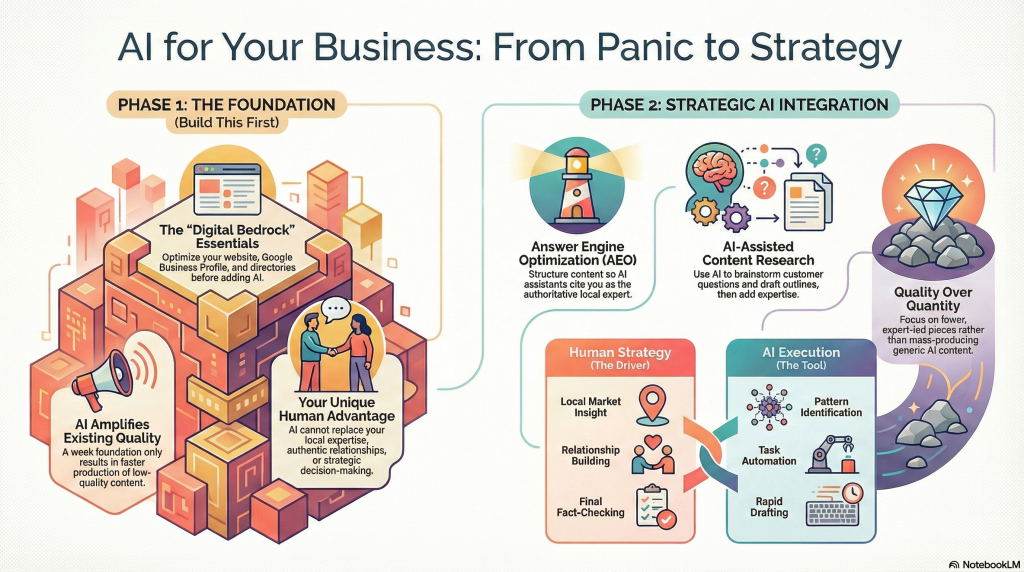
Build This BEFORE Worrying About AI
Before you implement any AI tools, you need:
✓ A professional website that clearly explains what you do, who you serve, and why customers should choose you,
✓ Fully optimized Google Business Profile with complete information, photos, and active management.
✓ Accurate business listings across major directories and citation sources.
✓ Basic on-page SEO (proper titles, meta descriptions, header structure, mobile-friendly design).
✓ Clear service pages that speak to your ideal customer’s needs.
✓ Customer reviews and testimonials that build trust.
AI’s role at this stage:
Use AI to help write compelling service descriptions, optimize your Google Business Profile copy, and create clear messaging, but the strategy, structure, and local expertise must come from you.
Why this matters:
AI tools amplify what you already have. If your foundation is weak, AI just helps you create more weak content faster. But if your foundation is solid, AI helps you execute more efficiently.
Where AI Becomes Powerful
Once your foundation is solid, you’re ready to use AI to capture people actively searching for your services.
Strategic AI applications at this stage:
1. AI-Assisted Content Creation:
- Use AI to help research what questions your customers are asking
- Generate outlines for comprehensive content that answers those questions
- Draft initial content that you then refine with your expertise
- Create variations of successful content for different platforms
2. Answer Engine Optimization (AEO):
- Optimize your content so AI assistants cite you as the expert
- Structure content for voice search and AI overviews
- Implement schema markup that helps AI understand your content
- Create FAQ content that AI assistants can easily extract
3. AI-Powered Keyword Research:
- Identify what your customers are actually searching for
- Discover question-based queries you should answer
- Find gaps in competitor content you can fill
- Understand search intent more deeply
4. Content Optimization:
- Analyze existing content and identify improvement opportunities
- Optimize underperforming pages based on AI insights
- A/B test headlines and copy variations
- Personalize content for different customer segments
The key: AI helps you execute your Active Searchers strategy more efficiently, but you still need to know WHAT to create, WHY it matters, and HOW it fits your business.
AI as a Scaling Tool
Once you’ve built your foundation and captured active searchers, you can use AI to scale and reach future customers.
Advanced AI applications at this stage:
- Scale content creation across multiple topics and formats
- Automate personalization for different customer segments
- Use predictive analytics to identify trends before competitors
- Implement AI chatbots for 24/7 customer engagement
- Automate follow-up sequences and nurture campaigns
But remember: This only works if the previous tiers are solid.
The Practical AI Strategy for Businesses (What to Actually Do)
So how should you actually approach AI as a business owner who’s feeling overwhelmed?
Step 1: Audit Your Foundation First (Before Touching Any AI Tool)
Before you invest in any AI tool or service, honestly assess:
Is your foundation solid?
- Is your website professional, mobile-friendly, and clearly communicates your value?
- Is your Google Business Profile complete and optimized?
- Are your business listings accurate across major directories?
- Do you have basic SEO elements in place?
- Can visitors easily understand your services and contact you?
If the answer to any of these is “no,” fix those first.
AI won’t help you if your foundation is cracked. In fact, it might make things worse by helping you create more content that sits on a weak foundation.
Step 2: Start with One Simple AI Application
Don’t try to implement AI everywhere at once. Start with one specific, high-impact application.
Best first AI applications for local businesses:
Option 1: AI-Assisted Content Research and Creation
- Use ChatGPT or Claude to identify questions your customers are asking
- Generate outlines for blog posts or service pages
- Draft initial content that you then refine with your expertise
- Impact: Create better content faster without the overwhelm of staring at a blank page
Option 2: Answer Engine Optimization (AEO)
- Optimize your existing content so AI assistants cite you as the expert
- Structure FAQ content for easy extraction by voice assistants
- Implement schema markup to help AI understand your content
- Impact: Get cited by AI assistants when people ask questions about your services
Option 3: AI-Powered Review Response
- Use AI to help draft thoughtful responses to customer reviews
- Maintain consistent, professional tone across all platforms
- Respond faster while still adding personal touches
- Impact: Better review management without spending hours crafting responses
Choose ONE. Master it. Then add more.
Step 3: Use AI as a Tool, Not a Replacement for Strategy
This is critical: AI is a tool that executes strategy. It’s not the strategy itself.
What AI CAN do:
✓ Help you research and analyze information faster
✓ Generate first drafts that you refine
✓ Identify patterns and opportunities in data
✓ Automate repetitive tasks
✓ Scale execution of proven strategies
What AI CANNOT do:
✗ Replace your unique expertise and perspective
✗ Understand your local market and specific customers
✗ Create strategy without human direction
✗ Build authentic relationships
✗ Make strategic business decisions
The rule: Use AI to help you execute faster and better, but you provide the strategy, expertise, and authentic voice.
Step 4: Add Your Expertise to Everything AI Creates
Never publish AI-generated content without adding your unique perspective, local knowledge, and expertise.
How to use AI content creation effectively:
- Use AI to generate the first draft (saves time, overcomes writer’s block)
- Review and fact-check everything (AI makes mistakes and “hallucinates” information)
- Add your expertise and experience (specific examples, local context, unique insights)
- Infuse your authentic voice (AI sounds generic; your personality makes you memorable)
- Include local and specific details (AI doesn’t know your market like you do)
- Update with current information (AI training data has cutoff dates)
The result: Content that’s created efficiently but still showcases your unique value.
Step 5: Monitor How AI Assistants Are Representing Your Business
You need to know what AI assistants are saying when people ask about your services.
How to monitor:
Ask AI assistants directly:
- “Who are the best plumbers in [your city]?”
- “How do I know if I need a new roof?”
- “What should I look for in an HVAC company?”
Check Google’s AI Overviews:
- Search for questions your customers would ask
- See if you’re being cited in the AI-generated summaries
- Identify who IS being cited if you’re not
Test voice search:
- Ask Siri, Alexa, and Google Assistant questions about your services
- Listen to what answers they provide
- Note whether you’re mentioned
What to look for:
- Are you being cited as a source?
- Who is being cited instead of you?
- What information are AI assistants providing?
- Are there gaps or inaccuracies you can address?
This tells you exactly where you stand and what opportunities exist.
Step 6: Focus on Quality Over Quantity
AI makes it easy to create massive amounts of content quickly. Resist the temptation.
Why quality matters more than ever:
- Search engines and AI assistants are getting better at identifying generic, low-value content
- Customers are overwhelmed by content and crave genuine expertise
- Google’s algorithms increasingly reward comprehensive, expert content over thin, keyword-stuffed pages
- AI-generated content is everywhere, your unique expertise is your competitive advantage
What to do instead:
Create fewer, better pieces of content that genuinely help your customers and showcase your expertise. Use AI to help you create that content faster—not to create more mediocre content.
Step 7: Stay Focused on Your Customers, Not the Technology
The biggest trap is getting so focused on AI tools that you forget what actually matters: helping your customers solve their problems.
Questions to ask before implementing any AI tool:
- Will this help my customers find me more easily?
- Will this help me serve my customers better?
- Will this save me time so I can focus on what I do best?
- Does this fit into my overall marketing strategy?
- Am I implementing this because it actually helps, or because I’m afraid of falling behind?
If the answer isn’t clearly “yes” to the first three questions, don’t do it yet.
Common AI Fears (And The Reality Behind Them)
Let’s address the specific fears that might be keeping you up at night:
Fear: “I’m already too far behind to catch up.”
Reality: Most small businesses haven’t meaningfully implemented AI yet. You’re not behind, you’re in the majority. And those who have rushed to implement AI without strategy are often wasting money.
What to do: Focus on building your foundation first, then add AI strategically. This puts you ahead of businesses trying to build AI on a weak foundation.
Fear: “AI is too complicated for me to understand.”
Reality: You don’t need to understand how AI works any more than you need to understand how your car engine works to drive. You need to understand what it can do for your business and how to use it effectively.
What to do: Start with simple, user-friendly AI tools designed for non-technical users. Focus on one specific application at a time.
Fear: “I’ll invest in the wrong AI tools and waste money.”
Reality: This is a valid concern and many businesses do waste money on AI tools they don’t need or can’t effectively use.
What to do: Start with free or low-cost AI tools (like ChatGPT’s free version) to learn what works for you before investing in expensive platforms. Focus on tools that solve specific problems you actually have.
Fear: “By the time I learn one AI tool, it’ll be outdated.”
Reality: While AI is evolving rapidly, the fundamental principles of good marketing don’t change. Strategy, understanding your customers, and providing value will always matter.
What to do: Focus on foundational skills (content creation, customer understanding, strategic thinking) that remain valuable regardless of which specific tools you use.
Fear: “AI will replace the personal touch that makes my business special.”
Reality: AI can’t replace authentic relationships, local expertise, and personal service. These are your competitive advantages.
What to do: Use AI to handle repetitive tasks and content creation so you have MORE time for the personal interactions that build your business.
Fear: “My competitors are using AI to get ahead while I’m stuck.”
Reality: Your competitors are probably just as confused and overwhelmed as you are. And if they’re using AI without strategy, they’re not actually getting ahead.
What to do: Focus on building your marketing in the right order. A solid foundation with strategic AI implementation beats rushed AI adoption on a weak foundation every time.
The Future of AI for Local Businesses (And What You Should Actually Prepare For)
AI will continue to evolve. Here’s what’s coming and what it means for you:
More AI-Powered Search
What’s happening: Google, Bing, and other search engines are integrating AI overviews as primary results. Voice search and AI assistants are becoming the default way people find information.
What this means for you: Being findable means being cite-able. You need to optimize your content so AI assistants select you as the authoritative source.
What to do now: Implement Answer Engine Optimization (AEO) strategies ad structure content for easy extraction, use schema markup, create comprehensive FAQ content.
AI as the Default Customer Service Interface
What’s happening: Customers increasingly expect instant responses 24/7. AI chatbots and assistants are becoming the first point of contact.
What this means for you: You’ll need to provide instant initial responses, but with a clear path to human interaction for complex issues.
What to do now: Build your foundation so when you do implement AI customer service, it has accurate information to work with.
Personalization at Scale
What’s happening: AI makes it possible to personalize content, offers, and experiences for individual customers automatically.
What this means for you: Generic, one-size-fits-all marketing will become less effective. Targeted, personalized communication will win.
What to do now: Build your customer data and segmentation so you’re ready to personalize when the time is right.
AI-Assisted Decision Making
What’s happening: AI tools will increasingly help business owners analyze data and make strategic decisions.
What this means for you: You’ll be able to make better decisions faster—but you still need to understand your business and customers to ask the right questions.
What to do now: Focus on understanding your customer journey, what drives results, and what metrics actually matter for your business.
The bottom line: AI will become more integrated into how business works—but the fundamentals of understanding your customers, providing value, and building relationships won’t change.
AI Implementation Checklist: Your Step-by-Step Action Plan
Feeling less overwhelmed? Good. Here’s exactly what to do:
Phase 1: Foundation (Do This First)
- Audit your current marketing foundation
- Fix any issues with your website, Google Business Profile, and directory listings
- Ensure your basic SEO is solid
- Clarify your messaging and value proposition □ Understand what questions your customers are actually asking
Timeline: 2-4 weeks AI involvement: Minimal: use AI to help write copy, but focus on strategy and structure
Phase 2: First AI Implementation (Do This Second)
- Choose ONE AI application to start with (content research, AEO, or review response)
- Learn the tool thoroughly before adding more
- Create a process for using AI that includes your expertise and review
- Measure the impact on your business
- Refine your approach based on results
Timeline: 4-8 weeks AI involvement: Strategic: one specific application, used consistently
Phase 3: Optimization and Expansion (Do This Third)
- Optimize your content for Answer Engine Optimization (AEO)
- Monitor how AI assistants are representing your business
- Implement schema markup to help AI understand your content
- Add a second AI application once the first is working well
- Continue measuring and refining
Timeline: Ongoing AI involvement: Increasing: multiple applications, all supporting your strategy
Phase 4: Scaling (Do This Last)
- Automate repetitive tasks with AI
- Implement AI chatbots for customer service (if appropriate)
- Use AI for advanced personalization □ Leverage AI for predictive analytics and trend identification
- Continuously test and optimize
Timeline: 6+ months from start AI involvement: Comprehensive: But always supporting human strategy and expertise

Frequently Asked Questions About AI for Local Businesses
Do I need to use AI to stay competitive?
Yes and no. You need to be aware of how AI is changing customer behavior (especially how people search for businesses). But you don’t need to implement every AI tool to stay competitive. Focus on the applications that genuinely help your business and customers.
What’s the most important AI-related change for local businesses right now?
Answer Engine Optimization (AEO), optimizing your content so AI assistants cite you as the expert when people ask questions about your services. This is changing how customers discover businesses and should be a priority once your foundation is solid.
How much should I invest in AI tools?
Start with free or low-cost tools (ChatGPT free version, Google’s free AI tools) to learn what works for you. Only invest in paid tools once you’ve proven the value with free versions and have a clear ROI.
Will AI-generated content hurt my search rankings?
Not if you use it properly. Google doesn’t penalize AI-generated content, it penalizes low-quality, unhelpful content. If you use AI to create comprehensive, expert content that genuinely helps customers (and add your unique expertise), it can help your rankings.
How do I know if my content is optimized for AI assistants?
Ask AI assistants questions your customers would ask and see if you’re being cited. If you’re not, your content likely needs better structure, schema markup, and more comprehensive answers to common questions.
Should I hire someone to implement AI for my business?
It depends on your foundation. If your basic marketing foundation is weak, hiring someone to fix that first is more valuable than hiring someone to implement AI tools. Once your foundation is solid, strategic AI implementation help can be valuable, but make sure they understand your business and industry, not just the technology.
What if I make the wrong choice about which AI tools to use?
Start with free tools and small commitments. Test before you invest heavily. Focus on solving specific problems rather than implementing technology for technology’s sake. You can always change tools, but you can’t get back time wasted on tools that don’t fit your business.
How fast is AI really changing? Do I need to keep up with every new development?
AI is evolving rapidly, but you don’t need to chase every new development. Focus on foundational capabilities (content creation, search optimization, customer service) that will remain valuable regardless of which specific tools dominate. Let early adopters test the bleeding edge, you can adopt proven tools when they’re ready.
Your Next Step: Discover Your AI Opportunity with a Free AEO Audit
You don’t need to figure all this out alone. And you don’t need to implement AI everywhere at once.
What you need is clarity on where you stand right now and what specific opportunities exist for your business.
That’s why we’re offering free AEO (Answer Engine Optimization) audits for business owners who want to understand how AI currently sees their business and what they can do about it.
In your free AEO audit, we’ll:
✓ Analyze how AI assistants currently represent your business when people ask questions about your services
✓ Identify the questions your customers are asking that you should be answering
✓ Evaluate your content structure and optimization for AI extraction and citation
✓ Assess your marketing foundation to ensure you’re ready for AI implementation
✓ Show you specific opportunities to get cited by AI assistants and voice search
✓ Provide a clear, prioritized roadmap showing exactly what to do first, second, and third
✓ Answer your specific questions about AI and your business without the overwhelm
Who this is for:
- Local businesses feeling overwhelmed by AI and unsure where to start
- Businesses with a solid foundation ready to leverage AI strategically
- Business owners who want to stay competitive without chasing every shiny new tool
- Anyone who wants clarity on what AI actually means for their business
Who this is NOT for:
- Businesses without a basic online presence (website, Google Business Profile)
- Those looking for someone to “do AI for them” without understanding the strategy
- Anyone not willing to build marketing in the right order
The shift to AI-powered search is happening right now. Your customers are already asking AI assistants questions about the services you provide.
The question is: Are you the expert being cited, or are you invisible?
Schedule Your Free AEO Audit Now and discover exactly how to position your business in the age of AI, without the overwhelm, confusion, or fear of being left behind.
About Clay Jar At Clay Jar Marketing we’re not just another agency pushing random tactics. We are your marketing partner. We work alongside you to help you scale and grow your business while freeing up your time so that you can focus on what really matters. We’ve walked this path, we understand the struggle, and we’re here to help you succeed. Every potential partnership starts with our comprehensive Playbook consultation, a deep-dive analysis that shows you exactly what to build, in what order, to capture customers at every stage of their journey. Ready to get started?