Reading time: 8 minutes
If you’re a business owner, you’ve probably heard the buzz about AI and SEO. Maybe you’ve wondered if you’re falling behind because you’re not using the latest AI tools. Or perhaps you’re confused about what AI even means for your ability to get found online.
Here’s the truth: AI is changing how search engines work and how customers find businesses like yours. But before you panic or rush to buy the newest AI SEO tool, you need to understand what actually matters for your business.
And more importantly, you need to know where AI SEO fits in your overall marketing strategy—because without the right foundation, even the most advanced AI tools won’t help you.
The AI SEO Confusion That’s Costing Local Businesses
Let’s start with what’s happening right now in the business world.
Business owners are being bombarded with messages about AI:
- “Use AI to write your content!”
- “AI will revolutionize your SEO!”
- “If you’re not using AI, you’re already obsolete!”
So they panic. They buy AI writing tools. They generate dozens of blog posts. They stuff their websites with AI-created content.
And then… nothing happens. Or worse, their rankings actually drop.
Why?
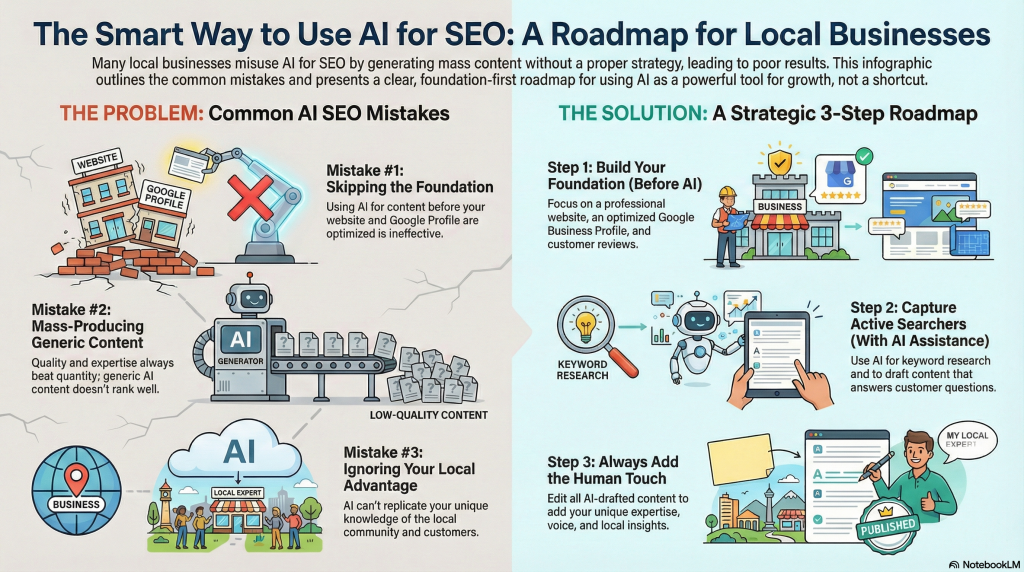
Because they skipped the foundation. They tried to build the roof before they had walls.
This is exactly the problem the Customer Activity Roadmap was designed to solve. AI SEO is a powerful tool, but it belongs in a specific place in your marketing journey.
Understanding AI SEO in Plain English
Before we talk about how to use AI for SEO, let’s clarify what we’re actually talking about.
AI SEO means using artificial intelligence tools to help with search engine optimization. This includes:
- AI content creation tools that help you write blog posts, service pages, and other content
- AI analysis tools that identify what keywords your customers are searching for
- AI optimization tools that suggest improvements to your existing content
- Search engines using AI (like Google’s AI overviews) that change how results are displayed
The most important thing to understand is this: AI doesn’t replace strategy. It amplifies it.
If your SEO strategy is weak or non-existent, AI will just help you create more weak content faster. But if you have a solid foundation and clear strategy, AI can help you execute more efficiently.
Where AI SEO Actually Fits in Your Marketing
Here’s where most local business owners get it wrong: they think AI SEO is a foundation-level strategy.
It’s not.
Build This BEFORE AI SEO
Before you worry about AI-generated content or advanced SEO tactics, you need:
- A professional website that clearly explains what you do and why customers should choose you
- A Google Business Profile that’s fully optimized and actively managed
- Basic on-page SEO (proper titles, descriptions, and structure)
- Customer reviews and testimonials that build trust
- Accurate, consistent business listings across major directories
- Strong citation profile that verifies your business
Why this matters: AI can help you create content, but if your foundation is weak, that content has nowhere solid to land. A beautifully written AI blog post won’t help if your Google Business Profile is incomplete or your website doesn’t clearly communicate your value.
AI’s role at this stage: Use AI to help write compelling service descriptions, optimize your Google Business Profile, and create clear, customer-focused copy for your core pages. But the strategy and structure? That needs human expertise.
Where AI SEO Becomes Powerful
Once your foundation is solid, you’re ready to capture people actively searching for your services. This is where AI SEO truly shines.
At this stage, you need:
- Strategic content that answers the questions your customers are actually asking
- Local SEO optimization that helps you appear when people search for services in your area
- Keyword research that identifies what your ideal customers are typing into Google
- Regular content creation that demonstrates your expertise
AI’s role at this stage:
- Keyword research and analysis: AI tools can quickly identify what your customers are searching for, which questions they’re asking, and what gaps exist in the current search results.
- Content creation acceleration: Once you know what topics to cover, AI can help you create comprehensive, well-structured content faster than writing everything from scratch.
- Content optimization: AI tools can analyze your existing content and suggest improvements to help it rank better.
- Competitive analysis: AI can quickly assess what your competitors are ranking for and identify opportunities you’re missing.
The key: AI helps you execute your Active Searchers strategy more efficiently—but you still need to know WHAT to create and WHY. The strategy comes first; AI is the execution tool.
AI as a Scaling Tool
Once you’ve built your foundation and captured active searchers, you can expand to reach future customers who don’t know about you yet.
At this stage, you might use AI to:
- Scale content creation across multiple topics and formats
- Personalize content for different customer segments
- Analyze trends to stay ahead of market changes
- Create variations of successful content for different platforms
But this only works if the previous tiers are solid.
The Practical AI SEO Approach for Local Businesses
So how should you actually use AI for SEO as a local business owner?
Step 1: Audit Your Foundation First
Before you touch any AI tool, honestly assess:
- Is your website professional and clear about what you offer?
- Is your Google Business Profile complete and optimized?
- Do you have basic SEO elements in place (titles, meta descriptions, header structure)?
- Can visitors easily understand your services and contact you?
If the answer to any of these is “no,” fix those first. AI won’t help you if your foundation is cracked.
Step 2: Identify Your Customer’s Questions
Use AI tools (like ChatGPT, Claude, or specialized SEO tools) to help you understand:
- What questions are your ideal customers asking?
- What problems are they trying to solve?
- What terms are they using to search for solutions?
But don’t just accept AI’s suggestions blindly. Validate them against your real customer conversations and experience.
Step 3: Create Strategic Content with AI Assistance
Once you know what to write about, use AI to:
- Generate outlines for comprehensive content that answers customer questions
- Draft initial content that you then refine with your expertise and unique perspective
- Optimize existing content by identifying gaps and suggesting improvements
- Create variations of successful content for different formats or platforms
Critical rule: Never publish AI-generated content without adding your expertise, local knowledge, and unique perspective. Google’s algorithms are increasingly sophisticated at identifying generic, AI-generated content that doesn’t provide real value.
Step 4: Monitor, Measure, and Refine
Use AI tools to:
- Track your rankings for important keywords
- Analyze which content is performing and why
- Identify new opportunities as customer search behavior evolves
- Optimize underperforming content based on data
The AI SEO Mistakes Local Businesses Must Avoid
As you incorporate AI into your SEO strategy, watch out for these common pitfalls:
Mistake #1: Mass-Producing Generic Content
Just because AI can create 50 blog posts in an hour doesn’t mean you should publish them. Quality always beats quantity in SEO.
What to do instead: Use AI to create fewer, better pieces of content that genuinely help your customers and showcase your expertise.
Mistake #2: Ignoring Your Local Advantage
AI doesn’t know your local market, your community, or your specific customer challenges the way you do.
What to do instead: Infuse AI-generated content with local knowledge, specific examples, and community context that only you can provide.
Mistake #3: Skipping the Human Touch
AI can write competently, but it can’t replicate your voice, your experience, or your unique perspective.
What to do instead: Use AI as a drafting tool, then edit heavily to add your personality, expertise, and authentic voice.
Mistake #4: Chasing Every AI Tool
New AI SEO tools launch every week. You don’t need to use all of them.
What to do instead: Choose 1-2 reliable tools that fit your workflow and master them before adding more.
Mistake #5: Forgetting the Foundation
The biggest mistake is using AI to create advanced SEO content when your basic foundation isn’t solid.
What to do instead: Follow the Customer Activity Roadmap. Build your foundation, then use AI to scale what’s already working.
Real-World AI SEO for Local Businesses: A Practical Example
Let’s say you run a local plumbing business. Here’s how you might use AI SEO strategically:
Foundation (Do This First):
- Ensure your website clearly explains your services, service area, and unique value
- Optimize your Google Business Profile completely
- Use AI to help write compelling service descriptions that include relevant keywords naturally
- Create clear, customer-focused content for your core service pages
Active Searchers (Do This Second):
- Use AI to identify common plumbing questions in your area (“Why is my water heater making noise?” “How to fix a leaky faucet?”)
- Create comprehensive blog posts answering these questions, using AI for initial drafts but adding your local expertise and specific examples
- Optimize for local search terms (“emergency plumber in [your city]”)
- Use AI to analyze which content is ranking and why, then create more of what works
Passive Searchers (Do This Third):
- Use AI to identify seasonal trends (when do people search for AC repair? Water heater replacement?)
- Create content calendars that address these trends before they peak
- Develop educational content that positions you as the local expert
- Use AI to repurpose successful blog posts into videos, social media content, and email newsletters
The result? You’re using AI strategically to support a solid marketing foundation, not as a replacement for strategy.
The Future of AI SEO (And What It Means for You)
AI and search engines are evolving rapidly. Google is increasingly using AI to understand search intent and deliver results. AI overviews are appearing in search results. Voice search is growing.
What this means for local businesses:
- Quality matters more than ever: As AI makes it easier to create content, search engines are getting better at identifying truly helpful, expert content versus generic AI-generated text.
- Local expertise becomes your advantage: AI can’t replicate your deep knowledge of your local market, your specific customer challenges, and your community relationships.
- User experience is critical: AI can help with content, but your website experience, loading speed, mobile optimization, and ease of navigation matter more than ever.
- Authenticity wins: Customers are craving genuine, authentic businesses they can trust. Your real experience, personality, and expertise are your competitive advantage.
So Should You Use AI for SEO?
Yes—but strategically.
AI is a powerful tool that can help you execute your SEO strategy more efficiently. It can help you research keywords, create content faster, optimize existing pages, and identify opportunities.
But it’s not a magic solution. And it’s definitely not a replacement for:
- A solid marketing foundation
- Clear strategy based on the Customer Activity Roadmap
- Your unique expertise and perspective
- Genuine customer relationships
- Quality over quantity
The bottom line: AI SEO works when it’s built on a solid foundation and used to amplify a clear strategy. It fails when it’s used as a shortcut to skip the foundational work.
Your Next Step
If you’re wondering how AI SEO fits into your specific business situation, start with an honest assessment:
- Is your foundation solid? (Website, Google Business Profile, basic SEO, clear messaging)
- Do you have a strategy for capturing active searchers? (Content that answers customer questions, local SEO, keyword targeting)
- Are you ready to scale with AI tools? (Or do you need to strengthen earlier stages first)
The Customer Activity Roadmap gives you a clear framework for making these decisions. It shows you exactly where you are, what to build next, and when advanced tools like AI SEO will actually help versus just adding complexity.
Want to know exactly where AI SEO fits in YOUR marketing roadmap?
Schedule a free Playbook consultation where we’ll evaluate your current marketing foundation, identify your biggest opportunities, and show you the exact order to build your marketing for predictable growth—including where and how to use AI strategically.
Because the goal isn’t to use every tool available. The goal is to build marketing that actually works for your business, in the right order, with the right strategy.
And when you do that, AI becomes a powerful accelerator instead of another confusing distraction.
At Clay Jar Marketing we’re not just another agency pushing random tactics. We are your marketing partner. We work alongside you to help you scale and grow your business while freeing up your time so that you can focus on what really matters. We’ve walked this path, we understand the struggle, and we’re here to help you succeed. Every potential partnership starts with our comprehensive Playbook consultation, a deep-dive analysis that shows you exactly what to build, in what order, to capture customers at every stage of their journey.
Ready to stop guessing and start growing? Schedule your free consultation and get your customized marketing roadmap.